
Executive summary
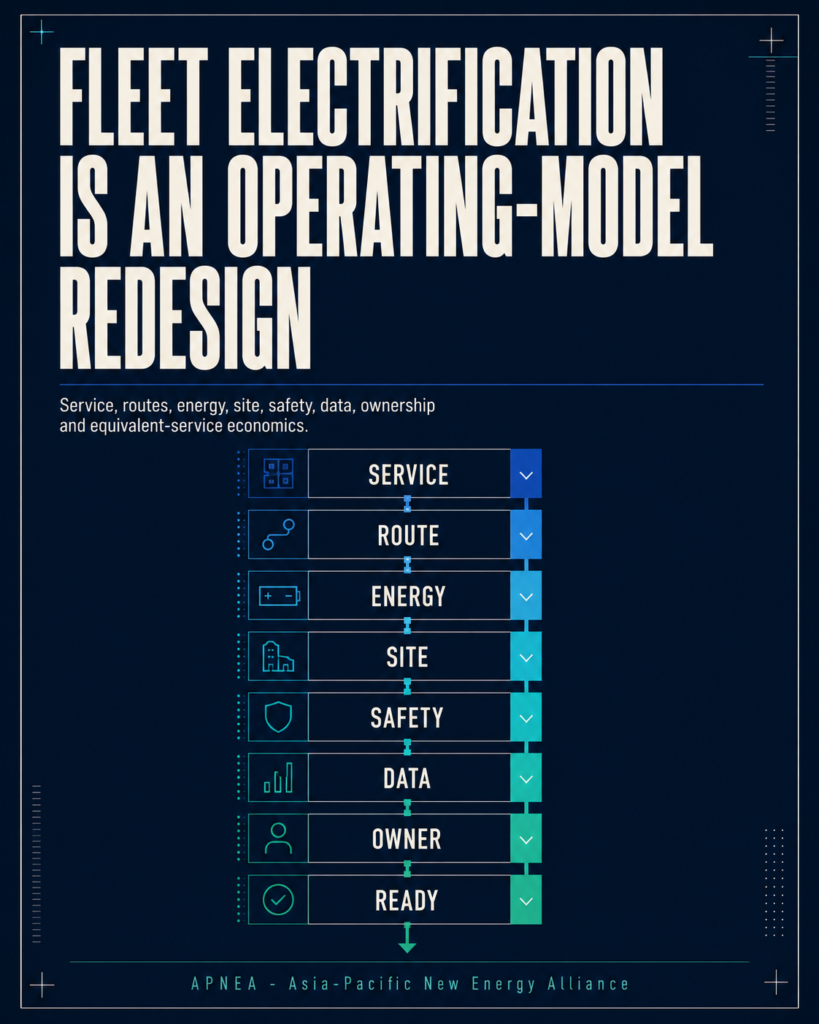
This fleet electrification operating model connects service duty, routes, charging, site readiness, safety, data, ownership and lifecycle economics.
Fleet electrification is often presented as a vehicle-procurement decision. In practice, it changes the operating model around the vehicle: the service definition, route planning, energy supply, charging windows, site capacity, maintenance, safety authority, data flows, financial assumptions and ownership of uptime.
The market context makes this distinction more important. The International Energy Agency expects global electric-car sales to reach 23 million in 2026, representing 28% of total car sales. Electric buses and trucks are also expanding, with depot charging and predictable routes acting as important enablers in several applications.13 Growth in vehicle availability does not remove the need to design the surrounding system.
A fleet can meet its brochure range and still fail the service. The route distribution may have been reduced to one average day. Charging windows may overlap with dispatch. Site capacity may not support simultaneous demand. Maintenance may lack a governed high-voltage work state. Data may be split across fleet, facilities and charging providers. Finance may compare purchase prices without pricing downtime, infrastructure or residual uncertainty.
This cornerstone analysis sets out an eight-part operating model. It starts with equivalent service, tests the difficult day, converts duty into an energy and charging plan, proves site readiness, establishes work control, assigns data and decision rights, compares lifecycle economics on a common boundary and uses a staged pilot-to-scale gate.
Electrification succeeds when the operating model is designed before the purchase order.
1. Define the service before selecting the vehicle
The first question is not which electric model should be purchased. It is which service cannot fail. The answer must describe the useful output the fleet is required to deliver: passengers moved, deliveries completed, service calls fulfilled, equipment transported, kilometres covered or operating hours preserved.
This service boundary becomes the comparison unit for every technology option. It should include route or task, passenger or payload condition, start and finish windows, required availability, quality and safety constraints, seasonal or weather exposure and expected operating life.
Without a common service unit, two vehicles can appear comparable while offering different operating outcomes. A lower acquisition or energy cost is irrelevant if the option requires more spare vehicles, changes the shift plan, reduces payload, misses a duty window or creates a recovery burden that the current service does not carry.
Equivalent-service definition
- Service unit: one defined unit of useful fleet output.
- Route or task: the work the asset must complete.
- Load: passenger, payload, equipment or towing condition.
- Time window: start, finish, dwell and recovery constraints.
- Availability: required ready state, spare strategy and maximum interruption.
- Quality and safety: conditions that cannot be traded away.
- Operating life: the period across which service and cost are compared.
Readiness signal: every option is tested against the same useful service boundary.
2. Map the difficult day, not only the average day
Fleet data is frequently compressed into daily averages. That can hide the days that determine whether electrification works. Averages smooth out route length, payload, temperature, congestion, auxiliary loads, driver behaviour, missed dwell periods, seasonal peaks and unexpected redeployment.
The operating model should therefore examine a distribution of duty, not one representative line. At minimum, it should identify the normal day, the high-demand day, the low-temperature or high-temperature day where relevant, the disrupted day and the recovery day after a charging or vehicle failure.
This matters because charging and fleet availability are linked. A vehicle that returns late may lose the energy window needed for the next shift. A charger failure may place several vehicles into the same recovery queue. A route change may push energy demand beyond the planned state-of-charge reserve. The difficult day exposes these dependencies before scale.
Duty evidence to retain
- Route distance, duration, elevation and traffic variability.
- Passenger, payload, equipment and auxiliary-energy conditions.
- Parking and dwell availability by location and time.
- Daily, weekly and seasonal peaks.
- Unplanned redeployment, missed charging and return-to-base delays.
- Minimum reserve and recovery requirement before the next duty.
Readiness signal: the fleet is sized and charged for operating variation, not an average that rarely occurs.
3. Convert the duty cycle into an energy and charging window
Vehicle energy demand and charging opportunity must be designed together. A fleet does not only need enough energy across the day. It needs the right energy at the right vehicle, location and time, without blocking dispatch or exceeding site constraints.
The IEA notes that depot charging is a crucial enabler for electric buses and that shorter-distance truck applications can rely on depot charging, while longer-distance operations increasingly depend on suitable public or dedicated heavy-duty charging.23 The charging model must therefore match the vocation, route pattern and recovery strategy rather than follow a universal charger specification.
The operating plan should define which vehicles charge first, the minimum departure state of charge, the maximum available power, the charging duration, which loads can be deferred, how charger sharing is controlled and what happens when a session fails. The energy plan should also reserve capacity for difficult days rather than allocate every available kilowatt-hour to the normal schedule.
Charging-window control
- Vehicle return time and required next departure.
- Energy required for the next duty plus operating reserve.
- Charger power, connector availability and simultaneous-session limit.
- Building demand, grid limit and managed-charging rules.
- Priority between operationally critical and deferrable vehicles.
- Fallback route for failed sessions, unavailable chargers or late returns.
Readiness signal: every vehicle has an accountable energy window and a recovery route.
4. Prove that the site can operate the charging system
A charger can be technically compatible and still be operationally unusable. Site readiness includes electrical capacity, connection lead time, switchgear, protection, cable routing, ventilation where required, physical access, parking geometry, drainage, lighting, communications, fire and emergency interfaces, maintenance access and room for future expansion.
The site should be tested under simultaneous demand rather than one charger at a time. The review should identify the building load that already occupies the power budget, the firm import limit, the effect of managed charging, the consequences of communication loss and the safe local state when central controls are unavailable.
Physical layout also affects service. A public charger may exist but remain unsuitable for a truck because of manoeuvring, bay length, queueing or connector access. The IEA reports that only a small share of public light-duty charging locations may be usable by trucks in practice, illustrating why charger count alone does not prove operational access.2
Site acceptance questions
- What is the firm electrical envelope at the time the fleet needs it?
- Which load has priority when the site approaches its limit?
- Can vehicles enter, connect, queue and exit without disrupting operations?
- Which communications, payment, authentication or backend services are required?
- What local control remains when a network or cloud service is unavailable?
- Which evidence proves commissioning, protection, fallback and restoration?
Readiness signal: the site has proved normal flow, constrained flow and degraded operation.
5. Make high-voltage safety a work-control system
High-voltage safety does not begin with personal protective equipment. It begins with control of the work. Before maintenance starts, the organisation must know the vehicle state, the energy sources, the authorised task scope, the isolation method, the verification required, the stop conditions and the person who can release the asset back into service.
Singapore Workplace Safety and Health Council guidance requires safe work procedures for electrical maintenance and identifies de-energisation, isolation, stored-energy control and verification as minimum lockout and tagout elements. Its April 2026 guidance also emphasises trained workers, identification of hazardous-energy sources, effective isolation devices, locks, tags and usage records.56
Vehicle and battery safety requirements also sit within technical and regulatory frameworks. UN Regulation No. 100 addresses electric power-train and rechargeable electrical energy storage system safety for relevant vehicle type-approval contexts.7 Compliance with a vehicle requirement does not replace the operator’s responsibility to govern maintenance, competence, incident response and return to service.
Work-control sequence
- State: confirm the vehicle and energy state before the task.
- Authority: define the exact work scope and competence required.
- Isolation: identify, control and secure all hazardous-energy sources.
- Verification: prove the safe condition before work begins.
- Exception: define stop-work and escalation triggers.
- Release: verify safeguards, records and service condition before return.
Readiness signal: authority, energy control and evidence move together through the task.
6. Put data and operating ownership into the design
Fleet electrification creates interfaces between fleet operations, facilities, energy management, charging providers, vehicle suppliers, maintenance teams, finance and sustainability reporting. Each function may hold part of the data while no one owns the complete operating outcome.
The operating model should assign ownership for vehicle availability, charging completion, site capacity, charger uptime, maintenance release, safety events, electricity cost, software access, data quality and escalation. A dashboard cannot resolve ambiguity in decision rights. The data must lead to a named action, threshold and owner.
Minimum data should include route completion, energy consumed, arrival state of charge, charging start and finish, failed sessions, charger availability, vehicle downtime, maintenance reason, energy tariff period and operational exceptions. Definitions should remain stable enough for performance and cost comparisons over time.
Interface ownership
- Fleet: service, route, vehicle assignment and availability.
- Facilities: site access, electrical assets and physical readiness.
- Energy: power budget, tariff exposure and charging priority.
- Safety and maintenance: work control, competence, incident response and release.
- Data and digital systems: access, integrity, retention, cybersecurity and fallback.
- Executive owner: complete service outcome and next decision gate.
Readiness signal: every critical interface has one accountable owner and an escalation path.
7. Compare total cost using equivalent service
Fleet total cost of ownership begins before the first price is entered. It begins by holding the service constant. Vehicles are comparable only when they deliver the same duty, load, time window, availability, safety condition and operating life.
The National Laboratory of the Rockies T3CO methodology uses an integrated lifecycle approach for commercial vehicles and accounts for varied duty cycles, direct costs and indirect effects such as charging or fueling dwell time, payload impacts and downtime.4 This supports a broader fleet principle: an option that appears cheaper at the asset level may be more expensive at the service level.
A decision-grade comparison should place costs in the period when they occur, allocate shared infrastructure transparently, value downtime through its service consequence and treat residual value as an uncertainty rather than a guaranteed offset. It should also test scenarios that stress the assumptions most capable of changing the decision.
Equivalent-service cost ledger
- Vehicle acquisition, financing or lease.
- Charging equipment, grid connection, civil works and shared site assets.
- Electricity, demand charges, software and network services.
- Maintenance, tyres, parts, training and specialist support.
- Charging dwell, payload or capacity effects and spare-vehicle requirements.
- Downtime consequence, service recovery and business interruption.
- Residual value, battery condition and end-of-life responsibility.
- Normal, downside, degraded and accelerated-scale scenarios.
Readiness signal: finance compares complete useful service, not isolated vehicle quotations.
8. Use a pilot to prove repeatability, not interest
A pilot should answer a bounded decision. It should not become a permanent demonstration that accumulates activity without resolving the next commitment. The pilot mandate should identify which service, route, charging, site, safety, data and economic assumptions must be tested, under which conditions and by what date.
Acceptance should cover normal operation, difficult days and degraded scenarios. Examples include a late-return vehicle, one charger unavailable, a tighter site power limit, loss of communications, a maintenance isolation and release, and a route or load variation that tests energy reserve.
Scale should be released only when the same controlled outcome can be repeated. The organisation should retain the mission records, exception history, recovery performance, configuration changes, training evidence and unresolved dependencies needed to decide whether to scale, redesign or stop.
Pilot-to-scale gate
- Authorised service and route boundary.
- Vehicle and charging configuration under control.
- Competent people and governed high-voltage work.
- Normal and degraded operating evidence.
- Traceable exceptions, incidents and learning actions.
- Equivalent-service cost and sustainability assumptions.
- One accountable owner, next gate and stop condition.
Readiness signal: scale is based on repeatable service, not the number of vehicles demonstrated.
One-page fleet electrification readiness memo
The operating model can be consolidated into a single decision memo. Detailed engineering, safety, commercial and legal evidence can sit behind it, but the gate should make each service dependency and owner visible.
| Decision field | Required answer | Evidence to attach |
|---|---|---|
| Service | The useful fleet output and non-negotiable conditions | Service definition, availability requirement and alternative analysis |
| Routes and difficult days | The duty distribution, peaks, exceptions and recovery needs | Telematics, route records, seasonal and disrupted-day analysis |
| Energy and charging | Energy required by vehicle, time and location | Energy model, charging windows, priority rules and recovery plan |
| Site readiness | The firm electrical and physical operating envelope | Capacity study, layout, commissioning, fallback and restoration evidence |
| Safety and maintenance | The governed work states and release controls | Competence, isolation, verification, incident and return-to-service records |
| Data and ownership | The definitions, thresholds and accountable interface owners | Data map, dashboard definitions, escalation rules and access controls |
| Equivalent-service economics | The common service boundary and complete lifecycle cost | Cost ledger, infrastructure allocation, downtime and scenario analysis |
| Pilot and scale | The evidence threshold, next gate and stop condition | Pilot mandate, acceptance record, exceptions and dated decision memo |
Conclusion
Fleet electrification is not a vehicle-replacement exercise. It is a redesign of how service, energy, infrastructure, safety, maintenance, data, finance and ownership work together.
A credible programme starts with equivalent service, studies the difficult day, assigns a charging window, proves the site, controls high-voltage work, establishes decision-grade data, compares lifecycle economics on the same boundary and uses a pilot to prove repeatability.
When these elements are designed before procurement, vehicle selection becomes more precise and scale becomes more defensible. When they are left until after delivery, the fleet may inherit an operating model that is expensive, fragile or unsafe to recover.
Design the service system first. Then select the vehicles that can prove they belong inside it.
Selected references
- International Energy Agency, Global EV Outlook 2026. Current electric-vehicle market context and the connected treatment of vehicles, charging, batteries, policy, electricity and emissions.
- International Energy Agency, Electric vehicle charging, Global EV Outlook 2026. Depot charging, heavy-duty charging constraints, range and site-access considerations.
- International Energy Agency, Trends in other EV modes, Global EV Outlook 2026. Electric bus and truck deployment context, including the role of depot charging and predictable routes.
- National Laboratory of the Rockies, T3CO: Transportation Technology Total Cost of Ownership. Integrated lifecycle-cost methodology covering duty cycles, direct costs, dwell time, payload effects, downtime and consistent technology comparisons.
- Singapore Workplace Safety and Health Council, Electrical Safety. Safe work procedures, de-energisation, isolation, stored-energy control, verification and competent electrical work.
- Singapore Workplace Safety and Health Council, Strengthening Lockout Tagout Practices, 9 April 2026. Current Singapore guidance on safe work procedures, training, hazardous-energy identification, isolation devices, locks, tags and usage records.
- United Nations Economic Commission for Europe, UN Regulation No. 100, Revision 3, Amendment 4. Electric power-train and rechargeable electrical energy storage system safety requirements in relevant vehicle type-approval contexts.
Use the evidence within its stated scope.
This cornerstone analysis provides a general systems framework for professional and institutional discussion. It synthesises APNEA campaign material on fleet readiness, high-voltage work control and equivalent-service economics with current primary and authoritative sources from the International Energy Agency, the National Laboratory of the Rockies, the Singapore Workplace Safety and Health Council and UNECE. It does not constitute project-specific legal, engineering, regulatory, workplace-safety, assurance, investment, vehicle-selection or certification advice. Duty cycles, charging infrastructure, electrical capacity, safety procedures, costs, regulations and acceptance requirements must be verified for the relevant fleet, site, configuration, jurisdiction and decision date.