
Executive summary
This EV charging readiness framework connects service demand, site power, managed charging, interoperability, fallback behaviour, reliability evidence and restoration ownership.
Charging infrastructure is often assessed through equipment count, nameplate power or a percentage uptime figure. Those indicators can be useful, but none proves that a driver or fleet can complete the required charging service. Readiness depends on the complete operating chain: demand, site power, physical access, equipment, vehicle interface, authorisation, communication, managed-charging policy, session completion, evidence and restoration.
The scale of charging deployment makes this distinction increasingly important. The International Energy Agency reported more than 7 million public charging points worldwide at the end of 2025 and nearly 1.8 million additions during that year. Capacity is expanding, but reliable service still depends on how infrastructure is designed, commissioned, operated and maintained.1
Singapore offers a useful lifecycle signal. From 1 April 2026, Technical Reference 25 was elevated to Singapore Standard SS 722, with expanded specifications and guidance covering the design, installation, maintenance and operation of EV charging systems.3 The implication is broader than one jurisdiction: hardware compliance and operational acceptance are connected, but they are not the same decision.
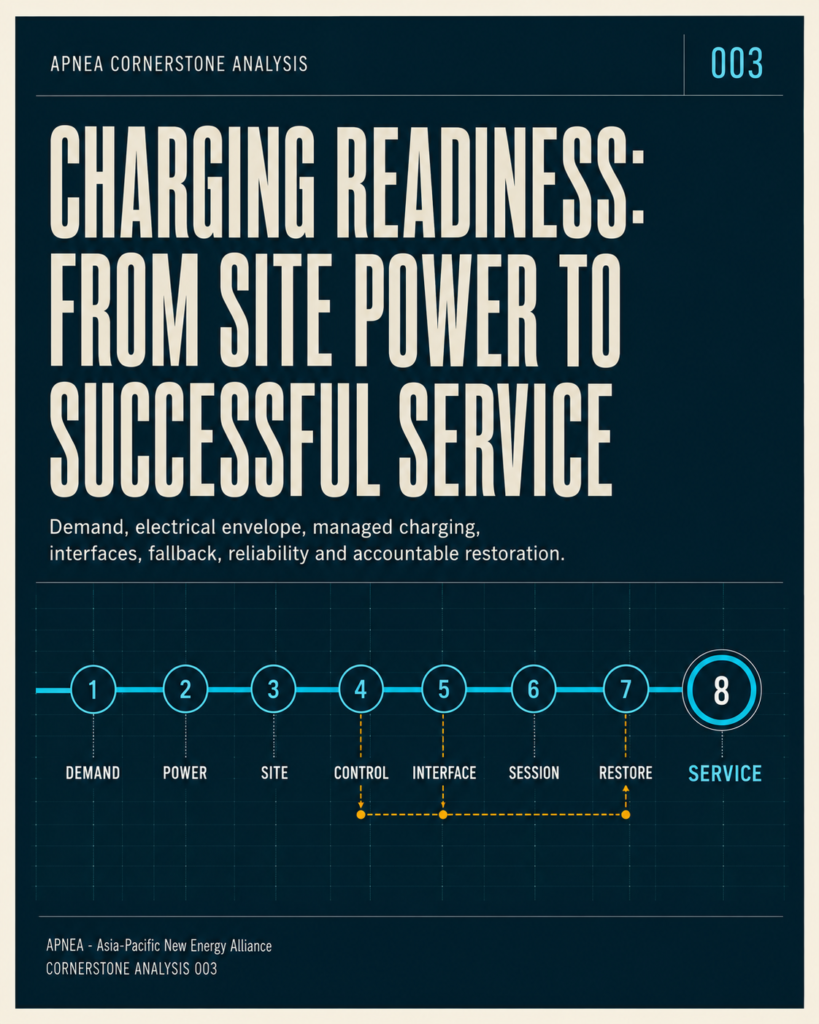
This cornerstone analysis sets out an eight-part EV charging readiness framework. It begins with a successful service definition, converts demand into a firm electrical envelope, proves the physical site, establishes managed-charging rules, governs interoperability and data, defines fallback and recovery, measures end-to-end reliability and assigns ownership for maintenance, restoration and change.
A charger is not ready because it is installed or online. It is ready when the required service can be completed, evidenced and restored under normal and degraded conditions.
1. Define successful charging service before selecting equipment
The first question is not how many chargers are required or which power rating should be purchased. It is which charging outcome must be delivered. For a public network, the outcome may be a discoverable, accessible and successfully completed charging attempt. For a fleet depot, it may be a defined amount of energy restored to each critical vehicle before departure. For a workplace, residence or destination site, it may be a reliable opportunity to charge within a longer dwell period.
A service definition prevents equipment metrics from becoming substitutes for user outcomes. A charger can report available while the bay is inaccessible, the connector is incompatible, authorisation fails, communication is unavailable, power is curtailed, the session terminates early or the transaction cannot close. Conversely, a brief equipment alarm may have no service consequence if another controlled route preserves charging.
The service boundary should identify who is charging, where the attempt begins, which interfaces must work, how much energy or time is required, what counts as successful completion and how degraded conditions are handled. This boundary becomes the reference for design, commissioning, operations and reliability reporting.
Successful-service definition
- User or fleet segment and the operating need being protected.
- Discoverability, access, bay availability and physical usability.
- Vehicle, connector, communication and authorisation compatibility.
- Required energy, charging duration or departure readiness.
- Payment, transaction closure and evidence where relevant.
- Maximum interruption and acceptable fallback route.
- Named owner for the complete charging outcome.
Readiness signal: the site has one explicit definition of a successful charging attempt or fleet-readiness outcome.
2. Convert charging demand into a firm electrical envelope
Nameplate charger power is not the same as available site power. The operating envelope is shaped by the grid connection, transformer and switchgear capacity, protection settings, building load, other flexible loads, losses, diversity assumptions, demand limits and any local generation or storage. It also changes over time as vehicles arrive, buildings operate and constraints appear.
The demand model should therefore start with service schedules rather than charger quantities. It should show when vehicles or users arrive, how much energy they need, the latest acceptable completion time, the degree of concurrency and the consequence of a missed charge. The model should test normal, peak and disrupted conditions instead of assuming all connected equipment can deliver its rated output simultaneously.
Smart and managed charging can help align EV load with site and grid conditions. The IEA treats charging flexibility as an important part of EV grid integration.2 However, flexibility must be expressed through an approved operating policy. It cannot be treated as a generic software feature that removes the need to define priorities and service deadlines.
Electrical-envelope evidence
- Firm grid or utility import limit and energisation conditions.
- Existing non-mobility load by time and operating state.
- Transformer, switchgear, protection and cable capacity.
- Charging demand by vehicle or user, energy deficit and deadline.
- Maximum simultaneous demand and approved diversity assumptions.
- Local generation, storage or demand-response contribution, if any.
- Normal, constrained, outage and restoration scenarios.
Readiness signal: the charging plan fits inside a verified time-dependent power budget, including a reserve for variation and recovery.
3. Prove the physical and electrical site as one operating system
A technically compatible charger may still be operationally unusable. Site readiness includes the electrical installation, but also cable routing, protection, drainage, ventilation where required, lighting, signage, accessibility, security, vehicle manoeuvring, bay geometry, queueing, connector reach, maintenance access and emergency response.
IEC 61851-1 establishes general requirements for conductive charging equipment, while IEC 61851-23 addresses DC EV supply equipment and related conformity testing in its scope.45 These technical requirements sit within a larger site acceptance case. The operator must still prove that the installed system is usable for the intended vehicle mix, service pattern and local environment.
Commissioning should test the site as a connected system rather than energising each charger independently and declaring completion. Simultaneous demand, protection behaviour, communication paths, authorisation, metering, emergency controls, backend functions, physical circulation and maintenance access should be examined under realistic operating conditions.
Site acceptance questions
- Can intended vehicles enter, align, connect, queue and leave safely?
- Is the electrical installation proven under the expected simultaneous load?
- Are protection, metering, emergency and isolation functions verified?
- Can maintenance be performed without creating unmanaged service or safety exposure?
- Are communications, authentication and backend dependencies known?
- Is the site usable during constrained power, partial equipment loss and recovery?
- Is future expansion possible without invalidating the present safety and power case?
Readiness signal: the site has proved physical flow, electrical performance and system interfaces under realistic load.
4. Turn managed charging into an approved operating policy
Managed charging is not equal power sharing. It is the controlled allocation of limited power against service deadlines. The rule must know the site ceiling, non-mobility load, reserve, connected vehicle, energy still required, departure time, service priority and consequence of missing readiness.
A simple equal-share rule may appear fair while leaving the most critical vehicle unready. A fastest-first rule may maximise completed sessions but undermine a scheduled departure. A cost-minimising rule may shift charging into a period that is too late for operations. The policy must therefore be approved by the functions that own service, energy, safety and commercial outcomes.
Open protocols can carry charging profiles and operational data, but they do not decide what the organisation values. OCPP 2.0.1 and OCPP 2.1 provide increasingly capable support for smart charging, device management, security and vehicle-infrastructure functions.678 The priority rule, reserve policy and escalation path remain an operating-governance decision.
Managed-charging rule set
- Site ceiling and protected non-mobility load.
- Vehicle or user energy need and latest completion time.
- Minimum departure reserve or service threshold.
- Priority classes and authority to override them.
- Reallocation logic after late arrival, fault or capacity reduction.
- Demand, tariff or grid-service constraints where relevant.
- Fallback rule and accountable owner for exceptions.
Readiness signal: one approved rule set determines who charges, when, how much and what happens when capacity falls.
5. Govern interoperability, identity and data as system interfaces
Charging service crosses multiple interfaces: vehicle to charger, charger to charging-management system, user or fleet identity to authorisation service, meter to transaction record, site controller to power limit, operator to maintenance system and network data to the customer or fleet platform. A failure at any one interface can prevent the end-to-end service even when the power electronics remain healthy.
OCPP is designed to support communication between charging stations and charging-management systems and to reduce dependence on closed proprietary integrations.6 OCPP capability is valuable, but a protocol label alone does not prove interoperability. Version, profiles, configuration, extensions, certificate handling, backend behaviour, roaming or payment connections, vehicle compatibility and implementation quality must be tested in the intended system.
The data model should also be agreed before operations begin. Asset identifiers, connector state, authorisation result, session start and end, energy delivered, failed attempts, power limitation, outage reason, maintenance action and restoration time need stable definitions. Without a common data dictionary, different teams can report contradictory reliability results from the same events.
Interface-control record
- Approved protocol version, profiles and security configuration.
- Vehicle, connector and charging-mode compatibility boundary.
- Identity, authorisation, payment or fleet-account dependencies.
- Metering, transaction and evidence-retention requirements.
- Site-controller and charging-management authority hierarchy.
- Data definitions, timestamps, identifiers and ownership.
- Change-control and regression-test requirements.
Readiness signal: every critical interface has an approved configuration, evidence trail and owner.
6. Define safe fallback and recovery before communications are lost
A connected charging system is incomplete while it depends on perfect communications. The site should know what remains authoritative when the charger, local controller, charging-management system, identity service, payment service, utility signal or cloud connection becomes unavailable.
The local system must preserve the electrical limit and any required safety state. It should also know whether authorised sessions may continue, which charging profile applies, how new sessions are treated, how transactions and meter data are retained, which conditions limit or stop charging and how state is reconciled after recovery.
OCPP includes security and operational capabilities, and the Open Charge Alliance has published an OCPP Security Operations Guide for implementers and operators.9 These capabilities support a controlled implementation, but the site’s offline policy, authority map and recovery acceptance test remain site-specific.
Four-phase outage rehearsal
- Normal: verify authority, state visibility and expected transaction flow.
- Loss: identify which component detects the break and how quickly the state becomes known.
- Offline: prove which sessions continue, limit, hold or stop and how the site limit remains protected.
- Recovery: reconcile commands, transactions, meter records, authorisations and configuration state.
- Change: test the same sequence after software, firmware, certificate or control-policy updates.
- Escalation: record who decides when local operation is no longer acceptable.
Readiness signal: communications loss produces a controlled, visible and recoverable operating state.
7. Measure end-to-end service reliability, not only equipment uptime
Uptime is an infrastructure metric. Service reliability is the outcome experienced by the driver or fleet. The Joint Office of Energy and Transportation describes the charging experience as the full chain from deciding to charge through successful completion, and its reliability work cautions against treating uptime as the only measure of that experience.12
A stronger model separates asset status from service outcome. It identifies whether the charging location was discoverable, accessible and usable; whether authorisation succeeded; whether power transfer began; whether the required energy or duration was achieved; whether the session closed correctly; and whether a failure was restored and proven.
EV-ChART provides a structured approach to charging-infrastructure data across station, session, uptime, outage, maintenance and cost modules.1011 The exact reporting model will vary by programme and jurisdiction, but the underlying lesson is transferable: reliability improves when failure states, service consequences and restoration evidence are consistently defined.
Reliability evidence chain
- Discoverable location and accurate operational status.
- Accessible bay, connector and physical interface.
- Successful identity, authorisation or payment step.
- Charging initiation and stable energy transfer.
- Required completion condition and usable energy delivered.
- Correct session closure, receipt and data record.
- Failure family, user consequence, restoration test and accountable owner.
Readiness signal: reporting shows whether the service succeeded, why it failed and whether restoration was proven.
8. Assign ownership for maintenance, restoration and controlled change
Charging infrastructure sits across site host, utility, electrical contractor, equipment supplier, network operator, software provider, maintenance organisation, payment or roaming service, fleet team and customer support. A contract can divide responsibilities without creating one accountable owner for the complete service.
The operating model should assign who receives alarms, who can access the site, who diagnoses remote and local faults, who carries spares, who controls software and configuration, who approves return to service, who communicates with users and who verifies that the failure has actually been removed. Administrative ticket closure is not the same as proven restoration.
The Alternative Fuels Data Center identifies operations, maintenance and the collection of uptime and utilisation data as important elements of successful charging-station management.13 Maintenance planning should therefore include preventive tasks, response times, parts strategy, software and certificate lifecycle, physical inspections, cleaning, cable and connector condition, calibration or metering requirements, security updates and periodic degraded-mode tests.
Operating-ownership covenant
- Service owner accountable for the complete charging outcome.
- Electrical and site owner for capacity, protection and physical access.
- Network and software owner for backend, security and configuration.
- Maintenance owner with site access, competence, tools and spares.
- Customer or fleet support owner for incident communication and workaround.
- Restoration authority with defined acceptance evidence.
- Change owner for firmware, software, certificates, tariffs and control rules.
Readiness signal: every failure family has a response route, restoration test and named accountable owner.
One-page charging readiness acceptance memo
The complete charging system can be reviewed through one decision memo. Detailed electrical studies, site drawings, protocol test results, cybersecurity evidence, contracts and maintenance procedures can sit behind it, but the acceptance gate should expose the operating dependencies and unresolved conditions.
| Decision field | Required answer | Evidence to attach |
|---|---|---|
| Charging service | The user or fleet outcome that must be completed | Service definition, successful-attempt criteria, operating hours and fallback route |
| Demand and power | The time-dependent demand and firm electrical envelope | Load profile, capacity study, connection conditions, reserve and constrained scenarios |
| Physical and electrical site | The installed system can be used safely under realistic load | Layout, accessibility, protection, metering, commissioning and emergency evidence |
| Managed charging | One approved policy allocates limited power against deadlines | Priority classes, energy needs, departure times, reserve, override and recalculation rules |
| Interoperability and data | Critical interfaces, configurations and records are controlled | Protocol profile, compatibility matrix, data dictionary, identity and transaction tests |
| Fallback and recovery | The site remains controlled when communications or services fail | Authority map, offline policy, outage rehearsal, reconciliation and escalation record |
| Service reliability | Success, failure consequence and restoration are consistently measured | Session outcome, failure taxonomy, uptime and outage data, user consequence and proof of restoration |
| Ownership and change | Operations, maintenance, restoration and configuration have accountable owners | RACI or covenant, maintenance plan, spares, response targets and change-control record |
Conclusion
Charging readiness is not a hardware count or a power-rating exercise. It is the controlled interaction of service demand, site power, physical access, equipment, communications, authorisation, managed charging, maintenance, data and accountable restoration.
A credible programme defines the charging service, proves the electrical envelope and site, approves the allocation rule, tests every critical interface, rehearses offline behaviour, measures the end-to-end attempt and assigns ownership for failures and change.
When these elements are designed and accepted together, charging infrastructure becomes an operating system that can support users and fleets through normal and degraded conditions. When they are separated, a site can appear available while the service remains unreliable.
Approve the service chain, not only the charger. Readiness begins at the power boundary and ends with a successful, evidenced and recoverable charging outcome.
Selected references
- International Energy Agency, Electric vehicle charging, Global EV Outlook 2026. Current charging-infrastructure context, charging-capacity metrics and the importance of accessible charging deployment.
- International Energy Agency, Executive summary, Grid Integration of Electric Vehicles. Framework context for managed charging and the integration of flexible EV load with power-system conditions.
- Enterprise Singapore, Singapore Elevates National Standard for Electric Vehicle Charging Systems. Singapore Standard SS 722 taking effect from 1 April 2026 and its expanded lifecycle scope for design, installation, maintenance and operation.
- International Electrotechnical Commission, IEC 61851-1:2017, Electric vehicle conductive charging system – Part 1: General requirements. General requirements for EV conductive charging equipment and relevant electrical-safety interfaces.
- International Electrotechnical Commission, IEC 61851-23:2023, DC electric vehicle supply equipment. Requirements for DC EV supply equipment, including conformity testing and selected control and energy-transfer functions.
- Open Charge Alliance, Open Charge Point Protocol. Official description of OCPP as the communication protocol between charging stations and charging-management systems, supporting interoperability and advanced charging functions.
- Open Charge Alliance, What Is New in OCPP 2.0.1. Device management, improved transaction handling, smart-charging inputs, ISO 15118 support and security profiles in OCPP 2.0.1.
- Open Charge Alliance, OCPP 2.1 Is Now Available. Current OCPP version context and expanded support for smart charging, ISO 15118-20 and future charging use cases.
- Open Charge Alliance, OCPP Security Operations Guide. Current operational security guidance for charging stations and charging-management systems, including secure implementation and operational practices.
- Joint Office of Energy and Transportation, Electric Vehicle Charging Analytics and Reporting Tool (EV-ChART). Standardised charging-infrastructure data submission and analytics across station, session, uptime, outage, maintenance and cost modules.
- Joint Office of Energy and Transportation, EV-ChART Data Format and Preparation Guidance. Definitions and structured data fields for charging sessions, uptime, outages, maintenance and other operational evidence.
- Joint Office of Energy and Transportation, Ensuring a Reliable Charging Experience. End-to-end charging-experience framing and the limitations of relying on equipment uptime alone.
- Alternative Fuels Data Center, U.S. Department of Energy, Operation and Maintenance for Electric Vehicle Charging Infrastructure. Operations, maintenance, data collection, utilisation and uptime considerations for successful charging-station management.
Use the evidence within its stated scope.
This cornerstone analysis provides a general EV charging readiness framework for professional and institutional discussion. It synthesises approved APNEA campaign material on charging capacity, site power, managed charging, smart-charging fallback and service reliability with current official sources from the International Energy Agency, Enterprise Singapore, the IEC, the Open Charge Alliance, the Joint Office of Energy and Transportation and the U.S. Department of Energy. It does not constitute project-specific legal, electrical-engineering, fire-safety, cybersecurity, workplace-safety, utility-connection, accessibility, procurement, investment, certification or regulatory advice. Site capacity, electrical design, charging equipment, communications, authorisation, payment, managed-charging rules, reliability definitions, maintenance obligations and acceptance requirements must be verified for the relevant site, vehicle mix, service, configuration, contracts, jurisdiction and decision date.