
Executive summary
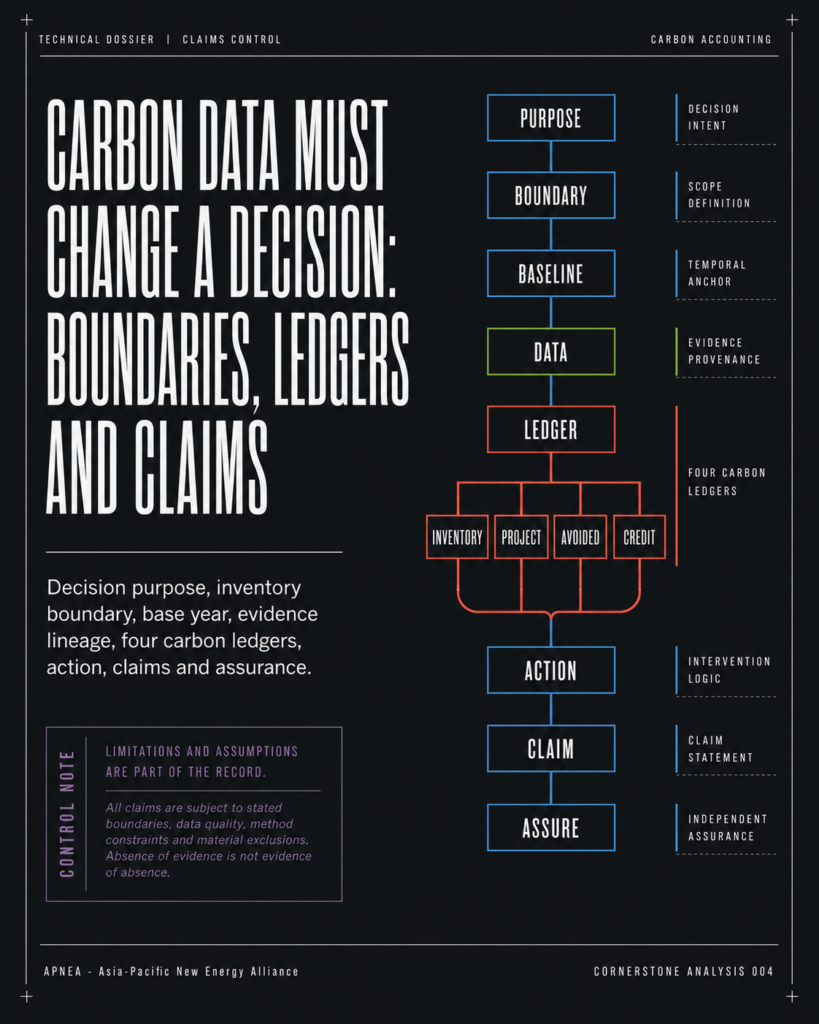
This carbon data governance framework connects decision purpose, boundaries, baselines, evidence, ledger selection, management action, claims and assurance.
Carbon reporting often begins as a measurement exercise and ends as a communications exercise. The management value sits between those two points. A carbon number becomes useful only when its boundary, baseline, source data, calculation method, uncertainty, ledger and accountable owner are clear enough to change a decision.
The first control is to name the question. A corporate inventory asks what the organisation emitted within a defined boundary. A project assessment asks what changed relative to a counterfactual baseline. An avoided-emissions estimate asks how one solution compares with an alternative. A carbon-credit record asks which issued unit was acquired, retired and claimed. These are related climate metrics, but they are not interchangeable accounting outputs.1345
This distinction matters because a persuasive number can still be decision-poor. It may use an incomplete boundary, an unstable base year, inconsistent emission factors, opaque supplier estimates, an untested counterfactual or a claim that merges gross emissions, operational reductions and credit use. The result can look precise while hiding what actually changed.
This carbon data governance framework connects nine controls: decision purpose, inventory boundary, base year, evidence chain, ledger selection, Scope 3 method, financial and operational use, claims governance, and assurance. It is designed to help sustainability, finance, procurement, operations and assurance teams work from one controlled carbon record without forcing different methods into one headline number.
A carbon number is decision-grade only when the reader can see what question it answers, which method produced it, what changed and who can act on the result.
1. Start with the decision, not the dataset
Carbon programmes frequently begin by collecting every available data field. That can create a large repository without clarifying which management decision it should improve. The better starting point is a defined use case: regulatory exposure, target tracking, capital allocation, procurement, product design, supplier engagement, project evaluation, external disclosure or a voluntary claim.
Different decisions require different levels of specificity and assurance. A screening exercise can use controlled secondary data to locate hotspots. A supplier contract or product claim may require primary activity data, a documented allocation method and stronger verification. A carbon-tax exposure model requires the taxable boundary, applicable rate, timing and liability rules. The data burden should be proportionate to the consequence of the decision.
Singapore illustrates why decision purpose matters. The National Environment Agency states that the carbon-tax rate is S$45 per tCO2e for emissions years 2026 and 2027.11 That price signal can change compliance exposure and investment economics, but it does not identify which operational measure should be funded. Management still has to connect tonnes to controllability, service consequences, capital requirements, contractual dependencies and timing.
Decision-purpose statement
- Decision to be made and the date by which evidence is required.
- Decision owner with authority to change budget, design, sourcing or operations.
- Carbon metric that is relevant to that decision.
- Required precision, frequency, comparability and assurance level.
- Financial, service, safety, legal or reputational consequence of error.
- Action threshold and escalation route when evidence is incomplete.
- Record that will show whether the decision changed the intended outcome.
Readiness signal: every material carbon dataset has a named decision, owner and evidence threshold.
2. Define the inventory boundary before calculating the total
A corporate inventory is bounded before it is calculated. The organisation selects a consolidation approach, identifies included entities and operations, defines direct and indirect emissions categories and applies the method consistently. The Corporate Standard provides the foundation for this organisational and operational boundary logic.1 ISO 14064-1 similarly specifies organisation-level requirements for the design, development, management, reporting and verification of a GHG inventory.9
Boundary choices are not administrative details. They determine which activities appear in the reported total, which functions own the source data, where exclusions are permitted and whether performance remains comparable over time. Two numbers with different consolidation approaches, operational boundaries, periods or Scope 3 category treatment should not be compared as though the difference represents operational performance.
Purchased energy also requires method discipline. The GHG Protocol Scope 2 Guidance standardises accounting for purchased electricity, steam, heat and cooling and includes requirements for location-based and market-based reporting where applicable.13 A contractual instrument can affect a market-based result, but it does not erase the need to disclose the method, instrument quality and corresponding location-based information.
Boundary control record
- Reporting entity, consolidation approach and included operations.
- Reporting period, gases, units and global-warming-potential basis.
- Scope 1, Scope 2 and Scope 3 categories included.
- Material exclusions and the reason for each exclusion.
- Purchased-energy method and contractual instruments used.
- Treatment of acquisitions, divestments, joint arrangements and outsourced activities.
- Named authority for boundary changes and restatement decisions.
Readiness signal: a reviewer can reconstruct why each source is inside or outside the reported inventory.
3. Govern the base year and recalculation policy before results move
A target is only meaningful when the starting line remains comparable. Acquisitions, divestments, outsourcing, insourcing, methodology changes, improved data and newly material sources can alter the relationship between the base year and the current year. Without a pre-agreed recalculation policy, the organisation can end up negotiating historical results after performance is known.
GHG Protocol implementation guidance identifies significant structural changes and significant methodological or data changes as circumstances that can trigger base-year recalculation.2 The purpose is not to remove real operational growth or decline. It is to preserve comparability when the organisational structure or measurement basis changes.
A controlled process defines the significance threshold, responsible functions, calculation method, approval authority and disclosure treatment in advance. It also preserves both the original and restated records so that users can see what changed. The same discipline should apply to targets, intensity metrics and financial models that use the emissions baseline.
Base-year governance questions
- Why was the base year selected and was its data sufficiently complete?
- Which structural, methodological or data changes trigger recalculation?
- What significance threshold applies and who approves its use?
- How are acquisitions and divestments treated consistently?
- Which historical years must be restated to preserve trend analysis?
- How are original values, revised values and reasons retained?
- How are targets, budgets and public disclosures updated after restatement?
Readiness signal: the base year can change only through a documented rule, approval and transparent restatement.
4. Build an evidence chain, not a spreadsheet total
A decision-grade result should be traceable from the reported number back to the underlying activity, period, source, factor, method and control. A spreadsheet may perform the calculation, but the evidence system must also show data ownership, version control, units, transformations, exclusions, estimation choices, uncertainty and review history.
The quality of a carbon number is multi-dimensional. Primary data can still be incomplete, misallocated or collected for a different period. A recognised emission factor can still be geographically weak or inconsistent with the activity definition. A highly detailed model can still be unsuitable for the decision if assumptions cannot be updated or challenged.
ISO 14064-1 provides organisation-level inventory principles and requirements, while ISO 14064-3 sets out requirements for validating and verifying GHG statements.910 Assurance readiness is therefore created during data design, not after the report is written.
Minimum evidence lineage
- Source activity and operational owner.
- Reporting period, unit and completeness status.
- Data source, extraction date and retained evidence.
- Emission factor, version, geography, technology and validity period.
- Calculation formula, allocation rule and transformation steps.
- Estimate, uncertainty and limitation statement.
- Reviewer, approval date and change history.
Readiness signal: every material carbon number can be traced to a controlled source, factor, method and owner.
5. Keep four carbon ledgers separate
Many carbon-accounting failures begin when one tonne is asked to perform four different jobs. Corporate inventories, project reductions, avoided emissions and carbon credits answer different questions and rely on different boundaries, baselines and evidence.
The corporate inventory records emissions assigned to the organisation within a defined boundary and period. Project accounting estimates the change caused by a specific intervention relative to a baseline scenario. Avoided-emissions analysis compares a product or solution with an alternative scenario and should be reported separately from the corporate inventory. A carbon-credit ledger records issued units, ownership, transfer, retirement and the claim made about their use.345
These ledgers can inform one strategy, but they should not be netted together without explicit rules. A project estimate is not automatically an inventory reduction. Avoided emissions are not a deduction from gross operational emissions. Retiring a credit does not rewrite the historical inventory of the emitting activity.
| Ledger | Question answered | Core boundary and method | Required reporting discipline |
|---|---|---|---|
| Corporate inventory | How much did the organisation emit? | Organisational and operational boundary; observed activity during the reporting period | Report scopes, methods, exclusions, base year and changes consistently |
| Project reduction | What did the intervention change? | Project boundary and counterfactual baseline scenario | Report project method, baseline, leakage, monitoring and uncertainty separately |
| Avoided emissions | How does the solution compare with an alternative? | Comparative assessment and reference scenario outside the inventory ledger | Disclose functional unit, scenario, time horizon, assumptions and limitations |
| Carbon credit | Which issued unit was acquired, retired and claimed? | Programme rules, registry chain, serialised unit and retirement record | Separate gross inventory, internal decarbonisation and credit use in the claim |
Readiness signal: the reader can identify which ledger produced every tonne and where that number must not be used.
6. Turn Scope 3 supplier data into a decision hierarchy
Scope 3 data can become an expanding questionnaire programme with weak connection to procurement or operational action. The Scope 3 Standard provides a corporate value-chain inventory method, while its technical guidance describes category-specific calculation methods and data sources.67 For purchased goods and services, available approaches can include supplier-specific, hybrid, average-data and spend-based methods. The right choice depends on the category, evidence and intended use.
Method selection should follow the decision. Spend-based data can support initial screening, but it may be too coarse for supplier performance tracking or design comparison. Supplier-specific data can improve relevance, but only when the boundary, period, product coverage, allocation, factor basis and assurance status are understood. More primary data is not automatically more comparable data.
GHG Protocol is actively revising Scope 3 requirements and guidance. Its March 2026 progress update discusses draft changes related to data quality, boundary setting, allocation and reporting, but expressly states that the material is under development and should not be treated as final.12 Organisations should use current published standards while monitoring revisions and retaining enough method provenance to update their systems later.
Supplier-data investment hierarchy
- Screen categories and suppliers to locate material hotspots.
- Name the sourcing, design, target or engagement decision to improve.
- Select a proportionate calculation method and required specificity.
- Preserve supplier, product, period, boundary and method provenance.
- Make allocation choices and secondary factors visible.
- Assess uncertainty and data quality by dimension.
- Invest first in the data gap most capable of changing action.
Readiness signal: supplier data effort is prioritised by decision value, materiality and the ability to influence action.
7. Connect tonnes to finance, procurement and operations
Carbon data changes performance only when it enters the operating forums that control assets, contracts, budgets and behaviour. Sustainability teams can define method and integrity requirements, but finance, procurement, engineering, operations and executive owners must convert the result into action.
A useful decision model links the emissions source to cash exposure, service impact, controllability, capital requirement, implementation time, contract dependency and residual risk. This prevents the organisation from ranking initiatives only by theoretical tonnes or headline abatement cost. A lower-cost reduction may be unavailable within the target period, incompatible with service requirements or dependent on a supplier that has not accepted the change.
Carbon pricing is one input to this model. In Singapore, the S$45 per tCO2e carbon-tax rate for emissions years 2026 and 2027 creates a direct cost signal for covered emissions.11 Management should distinguish that statutory exposure from internal carbon prices, scenario values, voluntary credit prices and avoided-cost assumptions.
Decision conversion fields
- Emissions source and accountable operational owner.
- Gross tonnes, trend and contribution to target or liability.
- Degree of direct control and external dependency.
- Action options, capital, operating cost and implementation lead time.
- Service, safety, quality and resilience consequences.
- Carbon price or scenario assumption and sensitivity range.
- Intervention threshold, review frequency and stop condition.
Readiness signal: the same review connects tonnes, cash, service, timing, dependency and ownership.
8. Treat claims as controlled outputs of the accounting system
A public claim should not be written first and supported later. It should be the controlled output of a defined ledger, evidence record, approval route and limitation statement. The claim owner should know whether the statement concerns gross inventory, progress against a target, project impact, comparative avoided emissions, renewable-energy accounting or carbon-credit use.
VCMI positions carbon-credit claims as action above and beyond science-aligned emissions reductions and provides requirements for credible use and communication.8 The practical governance point is to keep three records visible: what the organisation emitted, what changed inside its value chain and which external units were retired. Credit use may finance mitigation, but it should not obscure operational performance or be presented as though the emitting activity did not occur.
Comparative claims require similar restraint. GHG Protocol avoided-emissions guidance recommends transparent disclosure of the reference scenario, functional unit, system boundary, time period, data sources and limitations.5 A favourable comparison is not a universal property of a product. It is a result within a specified method and scenario.
Claim-control file
- Exact claim text and intended audience.
- Ledger and accounting method supporting the statement.
- Boundary, period, baseline or comparison scenario.
- Gross result before any separate credit or compensation statement.
- Data quality, uncertainty and material limitations.
- Registry, serial number and retirement evidence where credits are used.
- Technical, legal, communications and executive approval record.
Readiness signal: a reader can distinguish gross emissions, internal decarbonisation, comparative impact and credit use without inference.
9. Design assurance, ownership and change control into the system
Assurance cannot repair an uncontrolled inventory at the end of the reporting cycle. It can test the design and operation of controls, evidence and statements, but the organisation must first assign responsibility for source data, factors, methods, consolidations, estimates, recalculations, claims and corrections.
A mature carbon-control model separates preparation, review and approval. Operations confirms source activity. Sustainability owns accounting policy. Finance or data teams control consolidation and reconciliation. Procurement governs supplier evidence. Internal audit or an independent reviewer challenges control design. External assurance applies the agreed level and criteria. Communications cannot change the meaning of the approved result.
The system should also be ready for change. Standards, emission factors, regulations, organisational boundaries, data systems and business models evolve. The control record needs version history, effective dates, impact assessment, restatement rules and an owner for implementation. Current published requirements should remain the working basis until revised standards become final and applicable.
Carbon governance covenant
- Policy owner for boundary, base year, methods and ledger rules.
- Data owners for every material source and supplier interface.
- Calculation and consolidation owner with controlled access and versioning.
- Independent reviewer or assurance provider with defined criteria.
- Claim approver accountable for wording, evidence and limitations.
- Correction and restatement process for material errors or changes.
- Change owner for standards, factors, systems and reporting obligations.
Readiness signal: every material number and claim has an owner, reviewer, approval route and correction process.
One-page carbon decision and claims memo
The full carbon system can be reviewed through one decision memo. Detailed inventories, calculation workbooks, supplier evidence, project models, registry records and assurance files can sit behind it, but the decision gate should expose the method, limitations and ownership.
| Decision field | Required answer | Evidence to attach |
|---|---|---|
| Purpose | Which management, reporting or claim decision will use the number? | Decision owner, due date, consequence and evidence threshold |
| Boundary | Which entity, activity, product, project or value chain is included? | Consolidation approach, scopes, period, exclusions and method statement |
| Baseline | Which starting point or counterfactual governs comparison? | Base-year policy, recalculation rule, project baseline or comparative scenario |
| Data and factors | Can the result be traced to controlled evidence? | Activity data, factors, calculation, allocation, uncertainty and change history |
| Ledger | Which accounting question does the number answer? | Inventory, project reduction, avoided emissions or carbon-credit ledger selection |
| Action | Which budget, contract, design or operating decision changes? | Options, owner, tonnes, cash, service impact, timing and dependency |
| Claim | What may be communicated and what must remain separate? | Approved wording, gross result, reduction evidence, credit retirement and limitations |
| Assurance and change | Who reviews, approves, corrects and updates the result? | Control owner, assurance criteria, sign-off, restatement and standards-change process |
Conclusion
Carbon management fails when measurement, decision-making and claims are treated as separate projects. The inventory may be technically complete while the organisation still cannot identify which action should change. A project may report an impact that is later presented as an inventory reduction. An avoided-emissions estimate may be used without its comparison scenario. A credit retirement may be communicated as though gross emissions disappeared.
The remedy is disciplined separation and controlled connection. Define the decision. Establish the boundary and baseline. Preserve evidence lineage. Select the correct ledger. Use Scope 3 methods proportionately. Connect tonnes to cash, service and ownership. Build the claim only from the approved record. Design assurance and change control into the system.
When those controls are visible, carbon data becomes more than a reporting output. It becomes a management instrument that can redirect capital, improve procurement, focus supplier engagement, govern claims and show where the transition plan is or is not changing real operations.
Clarity begins by naming the decision and the ledger before presenting the number.
Selected references
- Greenhouse Gas Protocol, Corporate Standard. Corporate-level inventory boundaries, scope classification, accounting principles and the distinction between inventory accounting and project reductions used as offsets or credits.
- Greenhouse Gas Protocol, Corporate Standard Frequently Asked Questions. Current implementation guidance on significant structural and methodological changes that can trigger base-year recalculation.
- Greenhouse Gas Protocol, Project Protocol. Project-level quantification of GHG reductions relative to a baseline and confirmation that the Project Protocol is not designed for entity-wide corporate inventories.
- Greenhouse Gas Protocol, Inventory and Project Accounting: A Comparative Review. Explanation of the different assessment boundaries and the use of observed inventory data versus counterfactual project scenarios.
- Greenhouse Gas Protocol, Estimating and Reporting Avoided Emissions. Neutral framework for comparative product impacts and recommendations for more credible and consistent avoided-emissions disclosures.
- Greenhouse Gas Protocol, Corporate Value Chain (Scope 3) Standard. Corporate value-chain inventory methodology, category boundaries, reporting principles and the limitation on comparing different companies solely through reported Scope 3 totals.
- Greenhouse Gas Protocol, Technical Guidance for Calculating Scope 3 Emissions. Calculation methods, activity data, emission factors and method-selection guidance for the fifteen Scope 3 categories.
- Voluntary Carbon Markets Integrity Initiative, Claims Code of Practice. Guidance for credible voluntary carbon-credit use and claims as action above and beyond science-aligned emissions reductions.
- International Organization for Standardization, ISO 14064-1:2018, Greenhouse gases – Part 1. Organisation-level principles and requirements for quantifying, reporting, managing and verifying GHG inventories. ISO confirms the 2018 edition remains current after review in 2024.
- International Organization for Standardization, ISO 14064-3:2019, Greenhouse gases – Part 3. Principles and requirements for validation and verification of organisation, project and product GHG statements.
- National Environment Agency, Singapore, Carbon Tax. Current Singapore carbon-tax rate of S$45 per tCO2e for emissions years 2026 and 2027 and related compliance context.
- Greenhouse Gas Protocol, Scope 3 Standard Revisions Phase 1 Progress Update, March 2026. Current revision-process context for data quality, boundary setting, allocation and reporting. The document is expressly draft, subject to change and not a final standard.
- Greenhouse Gas Protocol, Scope 2 Guidance. Purchased-energy accounting, dual reporting and quality criteria for contractual instruments used in the market-based method.
Use the evidence within its stated scope.
This cornerstone analysis provides a general carbon data governance framework for professional and institutional discussion. It synthesises approved APNEA campaign material on decision-oriented carbon measurement, base-year governance, four-ledger separation and Scope 3 supplier-data prioritisation with current official sources from the Greenhouse Gas Protocol, ISO, the Voluntary Carbon Markets Integrity Initiative and Singapore's National Environment Agency. It does not constitute organisation-specific legal, tax, accounting, assurance, investment, carbon-market, product-claim, regulatory or sustainability-reporting advice. Boundaries, baselines, calculation methods, emission factors, supplier evidence, carbon-credit eligibility, claims, assurance criteria and regulatory obligations must be verified for the applicable entity, programme, jurisdiction, reporting period and decision date. GHG Protocol standards are under active revision in 2026; draft revision materials cited in this article are contextual only and must not be treated as final requirements.