
Executive summary
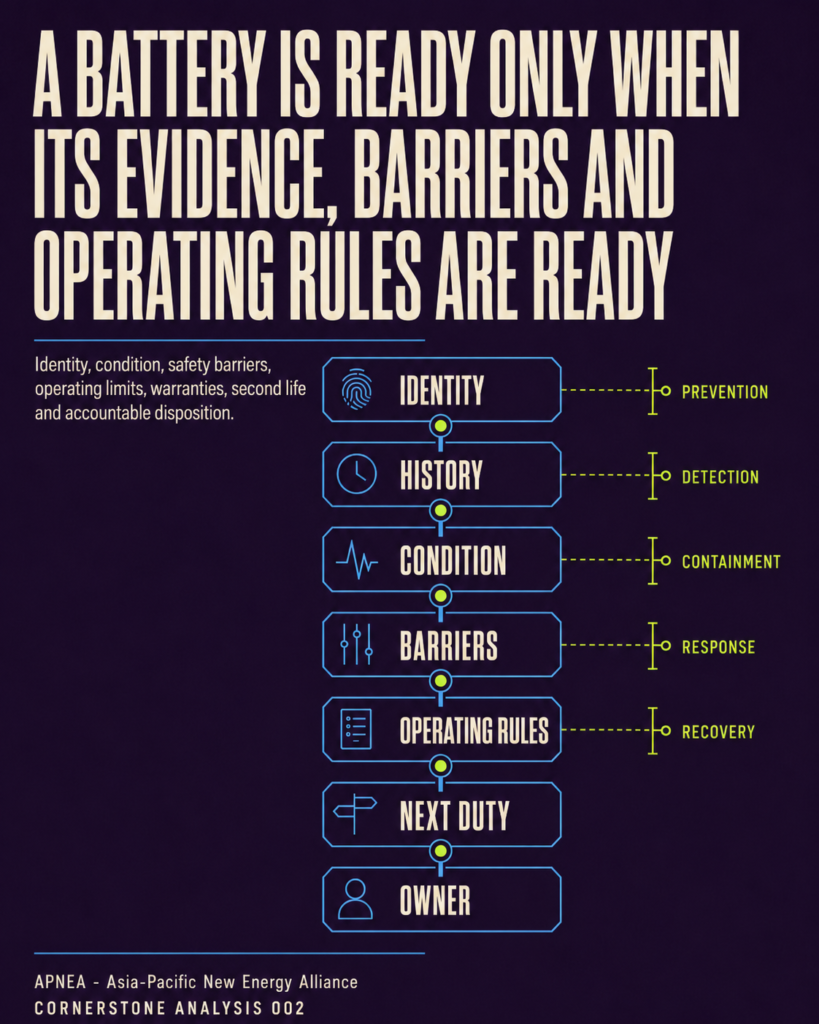
This battery lifecycle readiness framework connects identity, condition evidence, safety barriers, operating rules, warranties, second life and end-of-life ownership.
Battery readiness is often reduced to a state-of-health percentage, an age threshold or a successful charge-discharge test. None of those observations is sufficient on its own. A lifecycle decision also depends on verified identity, configuration, operating history, safety-relevant events, the intended next duty, the surrounding system, the controls that keep the asset inside its operating envelope and the person accountable for the next handover.
The standards landscape reflects this layered view. IEC 62619 addresses safety requirements and tests for industrial secondary lithium cells and batteries. IEC 62933-5-1 and IEC 62933-5-2 extend the discussion to grid-integrated energy storage and system interactions, while the 2026 IEC 62933-5-4 publication provides representative safety test methods for lithium-ion BESS. For vehicle applications, UN Regulation No. 100 addresses rechargeable electrical energy storage system safety in relevant type-approval contexts.123413
Traceability is also moving from good practice toward formal digital information requirements. Under Regulation (EU) 2023/1542, battery passports apply from 18 February 2027 to each light means of transport battery, each industrial battery above 2 kWh and each electric-vehicle battery placed on the EU market. Asia-Pacific organisations may operate under different laws, but the operational value of connected lifecycle evidence is not limited to one jurisdiction.11
This cornerstone analysis sets out an eight-part battery lifecycle readiness framework. It connects the decision boundary, evidence chain, condition assessment, safety barriers, operating rules, commercial protection, second-life suitability, circular responsibility and acceptance governance. It is designed to improve the quality of questions asked before continued use, repair, repurposing, integration or controlled end-of-life routing.
A battery is not ready because it still works. It is ready when the next duty is defined and the evidence, barriers and operating controls are strong enough to accept it.
1. Start with the next decision, not one health indicator
A battery can be safe for one state and unsuitable for another. It can retain useful energy but fail a power requirement. It can meet a laboratory test while carrying an incomplete operating history. It can remain electrically functional while its enclosure, cooling path, controls, communications or safety case no longer match the proposed application.
The review must therefore begin with a bounded decision. Is the battery being accepted for continued use in the same application, repair, module replacement, redeployment, repurposing into a different system, transport, storage, recycling or disposal? Each route creates different evidence, safety and ownership requirements.
The next duty must be described before suitability is judged. Required power, usable energy, duty cycle, temperature range, charge and discharge rates, operating reserve, enclosure, communications, monitoring, protection, site interface, maintenance regime and emergency response should be explicit. A statement such as “the battery still works” describes the present observation. It does not define acceptance for the next duty.
Decision boundary
- Same application or changed application.
- Expected service duty and operating life.
- Power, energy, thermal and availability requirements.
- Permitted configuration and software or BMS state.
- Maintenance, monitoring and emergency-response model.
- Named owner for acceptance, operation and final disposition.
Readiness signal: the next duty and acceptance authority are defined before condition evidence is interpreted.
2. Build a connected lifecycle evidence chain
Evidence should follow the battery through ownership changes, maintenance events, repairs, transport, storage and application changes. Fragmented records weaken safety decisions, warranty positions, residual valuation and cross-border confidence.
The minimum evidence set depends on the battery type and decision. However, the structure should connect six layers: identity, configuration, operating exposure, condition, safety events and custody. Regulation (EU) 2023/1542 demonstrates the direction of travel by establishing digital battery passports for specified categories. The regulatory requirement is European, but the underlying management principle is broader: decisions improve when the asset and its history can be distinguished from assumptions.11
Identity should not be limited to a serial number. The evidence chain may need to connect manufacturer and model, chemistry, manufacture date, pack or system structure, rated parameters, applicable software and BMS versions, authorised modifications and previous application. Custody records should show who held the battery, who performed work, which evidence was transferred and who accepted responsibility at each handover.
| Evidence layer | Typical records | Decision value |
|---|---|---|
| Identity | Manufacturer, model, unique identifier, chemistry, manufacture data | Confirms which asset and design basis are under review. |
| Configuration | Modules, components, BMS and software versions, authorised changes | Shows whether the assessed state matches the approved or intended configuration. |
| Operating exposure | Duty cycle, temperatures, charge and discharge history, storage periods | Connects degradation and safety questions to actual use. |
| Condition | Capacity, power, resistance or other approved indicators, thermal behaviour, imbalance | Supports a defined assessment rather than an age-only judgement. |
| Safety events | Alarms, faults, impact, immersion, overheating, isolation events, abnormal repair | Identifies events that may change suitability or require escalation. |
| Custody and ownership | Transfers, inspections, transport, integration, responsible owner and disposition | Prevents responsibility and evidence from disappearing between organisations. |
Readiness signal: a reviewer can reconstruct what the battery is, what it experienced, what changed and who owns the next decision.
3. Assess condition with a defined method and measurement boundary
Condition is not one universal number. Different batteries, applications and decisions may require different measurements, test conditions and acceptance criteria. Capacity, power capability, internal resistance, self-discharge, cell balance, isolation, thermal response, diagnostics and fault history can all matter, but the relevance of each measure depends on the duty and design.
Performance evidence should identify the method, test conditions, instruments, data quality, configuration, state of charge, temperature, rest periods and measurement boundary. Without those controls, results collected at different times may not be comparable. IEC 62933-2-1 defines general EES unit parameters and testing methods. IEC TS 62933-2-2 adds application-specific testing and duty cycles, and IEC TS 62933-2-3 addresses performance assessment after commissioning during site operation.567
The condition assessment should also preserve uncertainty. Missing history, inaccessible raw data, changed sensors, undocumented software updates or inconsistent test boundaries may be material. A technically plausible estimate should not be presented as directly measured evidence.
Condition evidence questions
- Which parameter is being measured and why is it relevant to the next duty?
- Under which temperature, state-of-charge, load and configuration conditions was it measured?
- Is the method repeatable and are the raw data retained?
- Which limits come from design information, contract, regulation, standard, test programme or project-specific engineering?
- Which uncertainty, missing history or data-quality limitation remains?
- Who is authorised to accept the result and define the next review interval?
Readiness signal: every reported condition value has a method, boundary, uncertainty and intended decision use.
4. Test the independence of prevention, detection, containment, response and recovery
Battery safety is not one feature. It is a set of barriers that must continue to reduce risk when another barrier is unavailable, delayed, defeated or outside its assumed condition. A credible review follows the failure pathway from initiating event to cell response, possible propagation, subsystem and system effects, site consequence, emergency decisions and recovery evidence.
IEC 62933-5-1 frames hazard identification, risk assessment and risk mitigation for grid-integrated EES systems. IEC 62933-5-2 addresses electrochemical EES safety as a system, including interactions between subsystems. IEC 62933-5-4, published in May 2026, adds representative test methods and procedures for lithium-ion battery-based BESS. These documents reinforce the need to examine the complete system rather than rely on a product claim alone.234
A barrier review should ask for the evidence supporting each control and the dependency that could weaken it. Detection may depend on power, communications, sensor placement or data interpretation. Containment may depend on spacing, enclosure, ventilation, suppression assumptions or access. Response may depend on clear authority, information availability, exclusion zones and trained resources. Recovery may depend on isolation, monitoring, investigation, evidence preservation and a controlled return-to-service decision.
Barrier-independence audit
- Prevention: which initiating events are reduced and under which operating conditions?
- Detection: how is abnormal behaviour identified, confirmed and escalated?
- Containment: what limits cell-to-cell, module-to-module, enclosure or site consequence?
- Response: who decides approach, isolation, exclusion, support and withdrawal?
- Recovery: how are residual hazards, evidence, repair, replacement and return to service controlled?
- Single-point test: what fails if the first or most trusted barrier is unavailable?
Readiness signal: the safety case does not assume that the first control will always work.
5. Translate performance and warranty language into operating rules
A warranty does not operate the battery. The control system, operating team and evidence process do. Commercial protection becomes fragile when the contract refers to capacity, throughput, duty cycle, temperature, state of charge, availability or degradation, but those terms are not translated into observable limits and retained records.
The operating model should convert each material term into a defined duty, measurable condition, control limit, data source, drift trigger, review owner and remedy path. IEC 62933-2-1, IEC TS 62933-2-2 and IEC TS 62933-2-3 provide an important performance-testing structure for EES systems from general parameters to application duty cycles and post-commissioning assessment.567
The contract remains project-specific, and this framework does not interpret legal entitlement. The management principle is that a term which cannot be observed and governed is difficult to protect. Data rights are therefore operational rights. The owner should know which raw data are available, how long they are retained, whether methods remain consistent and who can authorise a configuration or control change.
| Commercial or technical term | Operating translation | Evidence to retain |
|---|---|---|
| Duty cycle | Load, timing, charge and discharge pattern, reserve and environmental condition | Actual duty profile, control setpoints and deviations. |
| Performance threshold | Defined parameter, test method, boundary and acceptance point | Raw data, calibrated method, result and uncertainty. |
| Operating limit | Observable upper or lower limit with control and escalation rule | Setpoint history, alarms, overrides and authorisations. |
| Drift | Leading indicator, review interval and intervention trigger | Trend history, abnormal-event reviews and corrective actions. |
| Remedy | Pre-agreed decision path for correction, reconfiguration, repair or commercial review | Verified condition, cause review, service impact and authorised outcome. |
Readiness signal: every material performance term is linked to a control, an evidence record and an accountable remedy decision.
6. Treat second life as a new application, not a lower standard
Second life is not a second guess. A battery removed from its first application should not be accepted into another duty solely because it charges, discharges or retains a stated percentage of capacity. The next application may have different requirements for power, usable energy, thermal behaviour, enclosure, controls, communications, cycling pattern, maintenance and emergency response.
IEC 63338:2024 addresses reuse and repurposing of secondary cells and batteries after extraction from the first application. IEC TR 62933-2-201:2024 reviews testing and implementation issues for repurpose and reuse batteries in BESS. IEC 62933-5-3:2023 also recognises that reused or repurposed batteries, changes in chemistry, components, mode or site can impair the original state of safety and require additional control.8910
The decision sequence should verify identity and history, assess condition using a documented method, screen safety-relevant events, define the next duty and its acceptance criteria, assess integration and system-level safety, and assign responsibility through transport, installation, operation, maintenance and end of life.
Second-life acceptance sequence
- Verify identity, configuration and first-use history.
- Classify safety-relevant events, repairs and missing evidence.
- Assess condition with a method appropriate to the proposed duty.
- Define the new application load, environment and operating envelope.
- Assess enclosure, controls, communications, protection and system interfaces.
- Approve transport, integration, maintenance, emergency and end-of-life ownership.
- Reject or quarantine batteries where evidence or condition cannot support the decision.
Readiness signal: suitability is demonstrated for the new duty and system, not inferred from remaining capacity alone.
7. Make circularity a measured outcome with an accountable route
Circularity is not a product adjective. A battery can be technically repairable but never repaired, recyclable but not collected, or reusable but moved into a second application that creates more loss and complexity than value.
A credible circularity review defines the boundary, traces material and functional flows, measures value retained, identifies the duration of useful life, records energy, material and quality losses and selects indicators that can be applied consistently. ISO 59020:2024 provides requirements and guidance for measuring circularity performance within defined economic systems using structured indicators and reproducible data.12
The route should also protect safety and ownership. Stationary lithium-ion battery requirements in IEC 62485-5 cover installation, use, inspection, maintenance and disposal safety. Regulation (EU) 2023/1542 links battery sustainability, lifecycle information and waste-battery management. The applicable obligations vary by jurisdiction, but the management question remains: who owns collection, storage, transport, treatment, evidence transfer and final confirmation?1114
Circular responsibility questions
- Boundary: which battery, product, organisation and value network are assessed?
- Flow: which batteries and materials enter, remain in use, move, return or leave?
- Value: what function, material and economic value is actually retained?
- Duration: how much useful life is extended and under which duty?
- Loss: which energy, material, quality and safety burdens occur between cycles?
- Evidence: which indicators, records and disposition confirmations can be verified?
- Owner: who remains responsible until the route is demonstrably closed?
Readiness signal: the circular route has a defined boundary, measured outcome and named owner through final disposition.
8. Use one lifecycle acceptance gate
A battery lifecycle decision should bring technical, safety, operating, commercial and end-of-life evidence into one controlled gate. Separate teams may own parts of the evidence, but the acceptance decision cannot rely on disconnected approvals.
The gate should identify the proposed route, the evidence baseline, unresolved limitations, barrier dependencies, operating envelope, data rights, responsible owners, review date and stop conditions. It should also record the authorised outcome: continue, repair, reconfigure, repurpose, quarantine, recycle, dispose or reject.
The gate is not a universal pass mark. Acceptance criteria must be developed for the battery, application, system, site and jurisdiction. The value of the framework is to make the decision structure visible and to prevent important evidence or ownership questions from disappearing between lifecycle stages.
| Gate element | Minimum question | Possible outcome |
|---|---|---|
| Decision and duty | What route and service is being approved? | Continue, repair, repurpose, recycle or reject. |
| Evidence baseline | Can identity, history, condition and safety events be reconstructed? | Accept evidence, request more evidence or quarantine. |
| Barrier set | Which controls remain effective when another fails? | Approve controls, strengthen dependencies or hold. |
| Operating envelope | Which measurable limits and drift triggers govern the asset? | Operate, reconfigure or stop. |
| Commercial control | Are terms, data rights and remedies observable and authorised? | Protect position, revise terms or escalate. |
| Lifecycle ownership | Who owns transport, integration, operation, review and disposition? | Assign owner or do not proceed. |
Final readiness signal: the authorised route, evidence, controls, ownership and stop conditions are recorded together.
Conclusion
Battery readiness is a lifecycle management condition, not a label attached at manufacture or a percentage produced by one diagnostic tool. The decision must connect the battery identity and history to a defined next duty, an appropriate condition assessment, an independent safety-barrier set, measurable operating limits, retained evidence, commercial and data rights, and accountable end-of-life ownership.
For continued use, repair, repurposing or recycling, the strongest question is not “Does the battery still work?” It is “Suitable for which duty, under which controls, with which evidence and whose responsibility?”
Organisations that can answer that question consistently are better positioned to protect safety, performance, residual value, warranty rights, circular outcomes and regional confidence.
Sources and references
- International Electrotechnical Commission, IEC 62619:2022, Safety requirements for secondary lithium cells and batteries used in industrial applications. Safety requirements and tests for industrial secondary lithium cells and batteries, including stationary applications.
- International Electrotechnical Commission, IEC 62933-5-1:2024, Safety considerations for grid-integrated electrical energy storage systems. Hazard identification, risk assessment and risk mitigation for grid-integrated EES systems.
- International Electrotechnical Commission, IEC 62933-5-2:2025, Safety requirements for electrochemical grid-integrated EES systems. System-level electrochemical EES safety, including interactions between subsystems.
- International Electrotechnical Commission, IEC 62933-5-4:2026, Lithium-ion BESS safety test methods and procedures. Representative safety test methods and procedures for lithium-ion battery-based BESS.
- International Electrotechnical Commission, IEC 62933-2-1:2017, Unit parameters and testing methods for EES systems. General unit parameters and performance testing methods for EES systems.
- International Electrotechnical Commission, IEC TS 62933-2-2:2022, Application and performance testing. Application-specific testing methods and duty cycles for EES performance validation.
- International Electrotechnical Commission, IEC TS 62933-2-3:2025, Performance assessment during site operation. Performance validation and assessment after commissioning during site operation.
- International Electrotechnical Commission, IEC 62933-5-3:2023, Safety requirements for unplanned BESS modifications. Safety implications of changes in chemistry, design, components, mode, site or reused and repurposed batteries.
- International Electrotechnical Commission, IEC TR 62933-2-201:2024, Testing for repurpose and reuse batteries in BESS. Case studies and issues involving design, manufacturing, testing, operation and maintenance of BESS using repurposed or reused batteries.
- International Electrotechnical Commission, IEC 63338:2024, Reuse and repurposing of secondary cells and batteries. Reuse and repurposing after extraction from the first application, including the role of traceability and safety assessment.
- European Union, Regulation (EU) 2023/1542 concerning batteries and waste batteries. Lifecycle information, sustainability and waste-battery obligations, including battery passports for specified categories from 18 February 2027.
- International Organization for Standardization, ISO 59020:2024, Measuring and assessing circularity performance. Defined system boundaries, indicators, reproducible data and verifiable circularity assessment.
- United Nations Economic Commission for Europe, UN Regulation No. 100, Revision 4, Amendment 1. Electric power-train and rechargeable electrical energy storage system safety in relevant vehicle type-approval contexts.
- International Electrotechnical Commission, IEC 62485-5:2020, Safe operation of stationary lithium-ion batteries. Safety for installation, use, inspection, maintenance and disposal of stationary lithium-ion batteries.
Use the evidence within its stated scope.
This cornerstone analysis provides a general battery lifecycle readiness framework for professional and institutional discussion. It synthesises approved APNEA campaign material on lifecycle evidence, barrier independence, battery performance and warranty controls, second-life suitability and circularity with current official sources from the IEC, UNECE, the European Union and ISO. It does not constitute project-specific legal, engineering, regulatory, fire-safety, workplace-safety, warranty, insurance, transport, investment, asset-valuation, certification or end-of-life advice. Battery condition, operating limits, safety barriers, test methods, commercial terms, transport controls, repurposing acceptance and disposal routes must be verified for the relevant battery, system, site, duty, jurisdiction and decision date.