
Executive summary
This hydrogen project readiness framework tests the use case, product evidence, delivered cost, infrastructure chain, safety case, firm offtake and accountable ownership.
Hydrogen projects are frequently introduced through production capacity, technology type or national ambition. Those elements can be relevant, but none proves that hydrogen belongs in a particular system. A bankable and operable project needs a persistent service constraint, a defined product, credible emissions evidence, an affordable delivered pathway, complete infrastructure, a workable safety case, contractible demand and accountable ownership.
The market is advancing, but selectively. The International Energy Agency reported that low-emissions hydrogen production reached almost 1 million tonnes in 2025 and was expected to exceed 1% of global hydrogen production in 2026. At the same time, deployment remained below earlier expectations because cost gaps, uncertain demand, infrastructure constraints and policy delays continued to slow projects.13
Demand quality is especially important. In 2025, new offtake agreements for low-emissions hydrogen reached 1.7 million tonnes per year, but only one-fifth of the new volume was firm. Refining and industry remained the main areas of actual adoption, while other uses depended more heavily on mandates, support schemes or emerging lead markets.2
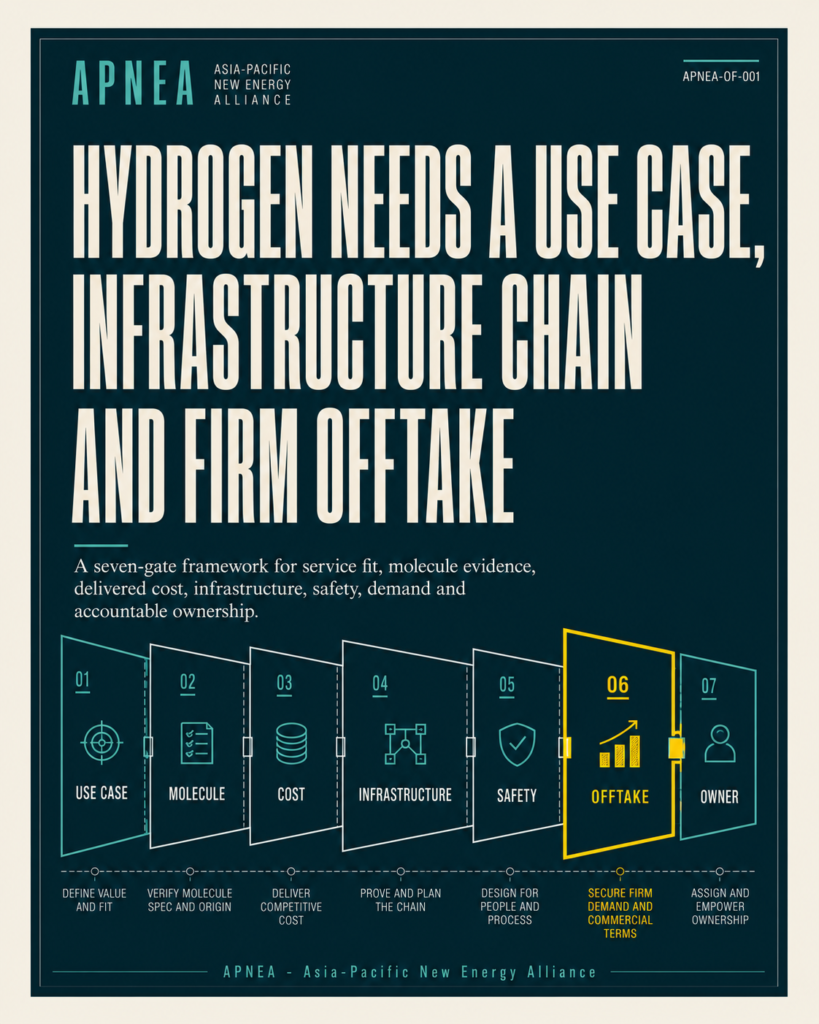
This operating framework provides seven gates for reviewing a hydrogen project before major capital commitment. The gates test service fit, product and emissions evidence, delivered economics, infrastructure closure, safety and operating capability, firm offtake, and ownership with stop conditions. The framework does not assume hydrogen is universally suitable or unsuitable. It requires the project to prove why hydrogen is the appropriate pathway for the defined service.
Hydrogen is not a use case. It is one possible pathway for delivering a defined industrial, mobility, energy or feedstock service.
1. Gate one: define the persistent service constraint
A project should begin with the service that must be delivered, not with a preferred molecule or production technology. The relevant question is what persistent constraint the organisation cannot solve acceptably through the incumbent system or a more direct alternative. Examples may include replacing existing fossil-based hydrogen in refining or chemicals, supplying a required reducing agent, producing a hydrogen-derived fuel, supporting long-duration or seasonal energy needs, or serving a transport duty where other pathways do not meet the operating envelope.
The service statement should identify the required output, location, timing, continuity, quality, flexibility and consequence of failure. It should also define the credible alternatives against which hydrogen will be tested. Direct electrification, efficiency, storage, process redesign, biogenic pathways, other low-emissions fuels and demand reduction may solve some constraints with fewer conversion steps. Hydrogen earns a place only when its complete pathway performs better against the decision criteria that matter.
The IEA notes that hydrogen can serve multiple applications and may contribute to energy security, but its use involves cost and infrastructure trade-offs. Wider system benefits also take time because projects require long development periods and depend on cumulative infrastructure deployment.3 This reinforces the need to define the service problem before announcing scale.
Use-case statement
- Service or product the project must deliver.
- Location, operating profile, duration and continuity requirement.
- Existing constraint that creates the need for change.
- Incumbent pathway and credible alternatives.
- Decision criteria: cost, emissions, safety, resilience, quality or market access.
- Minimum performance threshold and consequence of failure.
- Evidence that would disqualify hydrogen from further development.
Gate signal: hydrogen solves a defined and persistent constraint better than the available alternatives under the same service boundary.
2. Gate two: specify the product, pathway and emissions evidence
Hydrogen is often discussed as though every kilogram were equivalent. Commercially and environmentally, that is not true. A buyer may require hydrogen, ammonia, methanol, synthetic fuel, direct reduced iron or another derivative. The specification must define purity, pressure, temperature, carrier, contamination limits, certification, delivery state and any application-specific conditions.
Fuel quality affects compatibility, safety and performance. ISO 14687:2025 specifies minimum hydrogen quality characteristics across residential, commercial, industrial, vehicular and stationary applications.9 The project therefore needs an agreed product specification and a controlled method for sampling, analysis, non-conformance and release.
The emissions claim also needs a defined boundary. ISO 19870-1:2026 establishes a methodology for quantifying greenhouse gas emissions associated with hydrogen production from raw material extraction to the production gate.8 A project that transports, stores, converts or reconverts hydrogen needs additional downstream evidence so that the buyer understands the emissions at the relevant delivery or consumption point.
Labels such as green, blue, clean or low-carbon are not substitutes for pathway evidence. The acceptance record should identify the production route, electricity or feedstock source, temporal and geographic rules, capture assumptions where relevant, allocation method, conversion losses, transport boundary, certification scheme and data owner. Identical molecules can carry materially different emissions profiles.
Molecule and evidence record
- Exact product or derivative and application-specific quality specification.
- Production pathway, energy inputs, feedstocks and operating assumptions.
- Greenhouse gas calculation boundary and recognised methodology.
- Certification, chain-of-custody and book-and-claim rules where applicable.
- Sampling, measurement, verification and non-conformance process.
- Transport, storage and conversion emissions beyond the production gate.
- Data owner able to reproduce the result and explain uncertainty.
Gate signal: the buyer knows exactly what product will arrive, how its quality will be verified and what the emissions claim includes.
3. Gate three: model delivered service cost, not production cost
A production cost at the plant gate is not a delivered service cost. The complete economic model must include production, electricity or feedstock, water treatment, compression, liquefaction or chemical conversion, storage, transport, terminal handling, reconversion, losses, quality control, certification, balancing, maintenance, financing, insurance and contingency.
The cost boundary changes with the use case. A colocated industrial replacement may avoid major transport and reconversion steps. An export pathway may require conversion to ammonia or another carrier, port infrastructure, shipping, storage and possible cracking before the end user receives pure hydrogen. The IEA reports that where pure hydrogen is needed after maritime transport, liquefaction or reconversion can impose substantial additional energy use and cost.5
Cost acceptability is also application-specific. The IEA finds that policy support can narrow the cost gap, but in many regions and applications it does not eliminate it. Coordination can help allocate the green premium to participants or customers most willing or required to pay.4 The project should therefore show who carries the premium, under which policy assumptions and for how long.
Delivered-cost model
- Production cost under realistic utilisation, efficiency and input-price assumptions.
- Conditioning, conversion, storage and transport costs.
- Losses and energy consumption at every conversion step.
- Infrastructure tariffs, terminal charges and balancing costs.
- Certification, compliance, insurance, maintenance and contingency.
- Policy support, carbon value, premium allocation and expiry dates.
- Sensitivity to utilisation, power price, delay, exchange rate and demand shortfall.
Gate signal: the economic comparison reaches the buyer or service boundary and shows who carries every major cost and uncertainty.
4. Gate four: close the full infrastructure chain
A hydrogen project is a chain of connected assets and permissions. Depending on the pathway, that chain may include renewable generation or feedstock supply, grid connection, water, production, purification, compression, storage, pipeline or road transport, conversion, port and terminal capacity, shipping, import handling, reconversion, distribution and end-use equipment.
Each link needs a capacity, schedule, owner, technical interface, permit route and fallback. A production plant cannot create a functioning market if the connecting pipeline, storage cavern, port terminal, ammonia cracker, refuelling station or end-use conversion is late or undersized. Infrastructure interfaces also create quality, custody-transfer, pressure, metering, emissions and commercial boundaries that must be agreed.
The current global pipeline shows why this discipline matters. The IEA reports that trade would underpin more than 40% of announced low-emissions hydrogen volumes by 2030 if all projects materialised, but less than 8% of that trade-oriented volume came from operational, under-construction or committed projects. Announced hydrogen pipelines exceeded 40,000 km by 2035, while only 9% was operational or supported by committed investment. Announced underground storage also remained largely pre-investment.5
Infrastructure dependency map
- Every physical link from energy or feedstock input to the consumption point.
- Required capacity, pressure, quality, timing and utilisation for each link.
- Permits, land, grid, water, port and community dependencies.
- Technical and commercial interface at every custody-transfer point.
- Owner, investment status and critical path for each asset.
- Fallback, buffer storage and consequence of delay or outage.
- Integrated commissioning sequence across producer, infrastructure and user.
Gate signal: no critical link depends on an unnamed asset, uncommitted investor, untested interface or schedule that sits outside the project plan.
5. Gate five: prove safety and operating capability
Safety cannot be reduced to the equipment supplier declaration. Hydrogen systems involve application-specific hazards associated with combustion, pressure, low temperatures, material compatibility, leakage, ventilation, ignition, process control and human response. The relevant controls depend on quantity, pressure, physical layout, process, storage method, interfaces and surrounding operations.
H2Tools guidance recommends beginning hazard analysis with the project scope and preliminary design, involving technical specialists, facility management and workers, then examining what can go wrong, the consequence and likelihood, and the controls required.12 This analysis should connect design barriers with operating procedures, inspection, maintenance, work control, alarm response and emergency arrangements.
Applicable standards depend on the pathway. ISO 22734-1:2025 sets safety requirements for hydrogen generators using water electrolysis.10 ISO 19880-1:2020 covers design, installation, commissioning, operation, inspection and maintenance requirements for gaseous hydrogen fuelling stations.11 These standards inform the control system, but the project must still establish jurisdiction-specific compliance and a site-specific safety case.
Operating readiness includes competent people, maintenance access, spares, inspection, detection, isolation, emergency shutdown, permit-to-work controls, contractor governance and first-responder coordination. H2Tools also advises integrating hydrogen into the existing emergency response framework and ensuring relevant responders receive hydrogen-specific training.13
Safety and operations acceptance
- Application-specific hazard identification and risk assessment.
- Independent prevention, detection, isolation, ventilation and relief barriers.
- Materials, pressure, temperature and quality compatibility evidence.
- Commissioning, proof testing, inspection and maintenance requirements.
- Competence, permit-to-work, contractor and change-control arrangements.
- Alarm, emergency shutdown, evacuation and first-responder integration.
- Authority and evidence required for safe return to service.
Gate signal: technical controls and human response form one site-specific safety and operating case.
6. Gate six: make demand contractible
An expression of interest is not firm demand. The project needs a buyer, internal consumer or portfolio of users able to accept a defined product, volume, delivery profile, price structure, term and allocation of risk. These conditions must align with the production and infrastructure schedule.
The IEA reported 1.7 million tonnes per year of new low-emissions hydrogen offtake agreements in 2025, but only one-fifth of the new volume was firm.2 Separate IEA analysis notes that binding agreements have been important in enabling projects to pass final investment decision, while the majority of announced agreements remain preliminary.7
Contractability requires more than a headline volume. The contract must address specification, certification, take-or-pay or equivalent commitment, ramp-up, delivery point, balancing, outages, delay, change in law, carbon attributes, price indexation, credit support, termination and remedies. For a derivative, the agreement should define whether the buyer purchases hydrogen content, ammonia, methanol, fuel, steel or another end product.
The policy environment can create or support demand through quotas, public procurement, contracts for difference or sector rules. Current IEA reporting includes demand-support activity in Europe, Japan, China and other markets.6 A project should nevertheless separate durable customer demand from support that may be time-limited, conditional or exposed to implementation delay.
Five-rule offtake gate
- Specification: what exact product and evidence will the buyer accept?
- Volume: how much is firm, conditional, flexible or merely indicative?
- Delivery profile: when, where and at what quality and pressure?
- Price and term: which index, premium, support mechanism and duration?
- Risk: who carries delay, underperformance, infrastructure, policy and demand exposure?
Gate signal: the buyer can sign for a defined product, committed volume, deliverable profile, acceptable price structure and explicit risk allocation.
7. Gate seven: assign ownership, dependencies and stop conditions
Hydrogen projects bring together energy suppliers, technology providers, engineering contractors, infrastructure owners, ports, transport operators, end users, certifiers, regulators, financiers, insurers and public bodies. A collaboration agreement does not automatically create one accountable delivery system.
The project needs a dependency contract that links each required outcome to an owner, resource, assumption, evidence item, decision date and intervention rule. Where one participant depends on another asset or policy, the schedule and acceptance criteria must be visible to both parties. Unowned dependencies should be treated as project risks, not background assumptions.
Stop conditions are equally important. The project should define what evidence would trigger redesign, delay, reduction in scale or termination. Examples include inability to secure the required specification, failure to close the delivered-cost gap, lack of a permitted infrastructure route, unresolved safety risk, insufficient firm offtake, an unacceptable emissions result or loss of a critical support mechanism.
Project ownership covenant
- One accountable owner for the end-to-end delivered service.
- Named owner for every asset, permit, interface and data set.
- Integrated schedule linking supply, infrastructure and demand.
- Decision rights for design change, curtailment, shutdown and restart.
- Evidence gates before procurement, construction, commissioning and scale.
- Intervention thresholds and escalation path for missed dependencies.
- Explicit hold, revise and stop conditions before final investment decision.
Gate signal: every critical dependency has an owner, evidence date, intervention rule and consequence if it does not close.
One-page hydrogen project acceptance memo
The seven gates can be consolidated into one decision memo. Detailed engineering, commercial, legal, environmental, safety and financing records should sit behind the memo, but the approval body should be able to see the entire service chain and every unresolved dependency on one page.
| Decision field | Required answer | Evidence to attach |
|---|---|---|
| Use case | The persistent service constraint and why hydrogen is preferred | Service statement, alternatives comparison and disqualification criteria |
| Product and emissions | The exact molecule or derivative, quality and emissions boundary | Specification, quality plan, pathway data, certification and verification method |
| Delivered economics | The cost at the buyer or service boundary and who carries the premium | Integrated cost model, sensitivities, support assumptions and premium allocation |
| Infrastructure chain | Every asset and interface from input to consumption point | Dependency map, capacities, permits, owners, schedules and fallback |
| Safety and operations | The site-specific controls and capability for normal and abnormal operation | Hazard analysis, barrier register, competence, maintenance and emergency evidence |
| Firm offtake | The contractible demand supporting utilisation and investment | Term sheet or contract, specification, volume, delivery, price and risk allocation |
| Ownership and stop rules | The accountable delivery system and evidence-based intervention points | Integrated governance, decision rights, evidence gates and stop criteria |
Approval signal: all seven gates are closed or each remaining condition has an owner, deadline, evidence requirement and defined consequence.
Conclusion
Hydrogen projects progress when they are designed around a complete service chain rather than a production announcement. The use case defines why the pathway is needed. Product and emissions evidence define what is being delivered. The cost model shows whether the complete pathway is supportable. Infrastructure, safety and operating controls prove that it can function. Firm offtake creates dependable demand. Governance connects every dependency to an accountable owner.
This discipline does not prejudge hydrogen. It protects strong use cases from weak project architecture and prevents technology enthusiasm from substituting for service fit, infrastructure closure or commercial demand.
Use hydrogen where it solves a persistent constraint and where the full value chain can be specified, financed, operated, evidenced and contracted.
Approve the pathway only when the use case, molecule, infrastructure, safety case, offtake and ownership form one coherent operating system.
Selected references
- International Energy Agency, Global Hydrogen Review 2026. Current global hydrogen production, demand, policy, infrastructure, trade, investment and project-pipeline context.
- International Energy Agency, Demand, Global Hydrogen Review 2026. Current demand, offtake, sector adoption and firm-agreement context.
- International Energy Agency, Key questions about hydrogen, Global Hydrogen Review 2026. Project-delivery timelines, cost trade-offs, energy-security considerations and enabling conditions.
- International Energy Agency, Cost acceptability, Global Hydrogen Review 2026. Application-specific cost gaps, policy support and value-chain cost allocation.
- International Energy Agency, Trade and infrastructure, Global Hydrogen Review 2026. Pipeline, storage, terminal, carrier, conversion and cross-border infrastructure readiness.
- International Energy Agency, Policy, Global Hydrogen Review 2026. Current demand-creation, support-scheme and Asia-Pacific policy examples.
- International Energy Agency, What it would take to unlock the next phase of hydrogen growth. Firm offtake, investment decisions, existing hydrogen uses, lead markets and coordination barriers.
- International Organization for Standardization, ISO 19870-1:2026, Hydrogen supply-chain greenhouse gas methodology. Methodology for quantifying production-stage greenhouse gas emissions and supporting comparable hydrogen evidence.
- International Organization for Standardization, ISO 14687:2025, Hydrogen fuel quality – Product specification. Minimum hydrogen quality characteristics for residential, commercial, industrial, vehicular and stationary applications.
- International Organization for Standardization, ISO 22734-1:2025, Hydrogen generators using water electrolysis – Part 1: Safety. Safety requirements for hydrogen generators using water electrolysis.
- International Organization for Standardization, ISO 19880-1:2020, Gaseous hydrogen fuelling stations – General requirements. Design, installation, commissioning, operation, inspection and maintenance requirements for gaseous hydrogen fuelling stations.
- Hydrogen Tools, U.S. Department of Energy supported resource, Identifying and Analyzing Hazards. Application-specific hazard identification, risk analysis and control planning.
- Hydrogen Tools, U.S. Department of Energy supported resource, Emergency Response Framework. Emergency response integration, first-responder readiness and hydrogen-specific training.
Use the evidence within its stated scope.
This operating framework provides general project-governance guidance for professional and institutional discussion. It synthesises approved APNEA campaign material on hydrogen use-case discipline and firm offtake with current official sources from the International Energy Agency, the International Organization for Standardization and Hydrogen Tools. It does not constitute project-specific engineering, process-safety, environmental, legal, regulatory, commercial, financial, tax, insurance, certification, procurement or investment advice. Product specifications, emissions methods, delivered-cost assumptions, infrastructure capacities, permits, safety controls, standards, contracts, support mechanisms and acceptance criteria must be verified for the relevant pathway, application, site, counterparties, jurisdiction and decision date.