
Executive summary
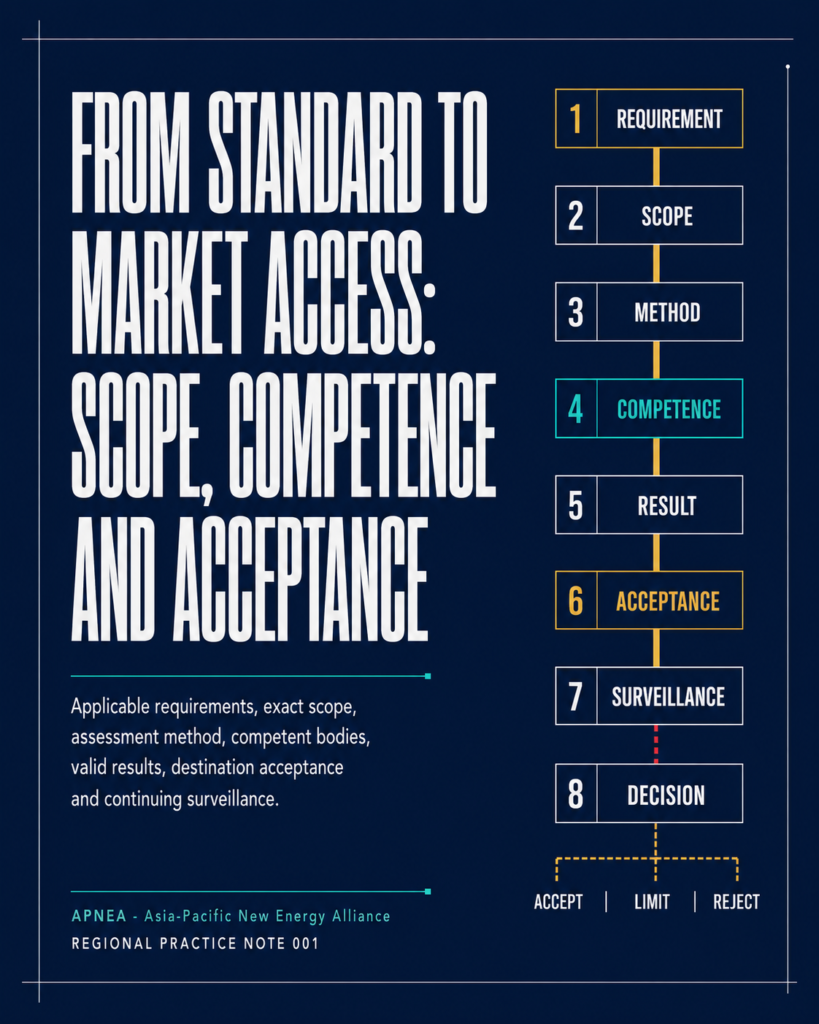
This conformity assessment market access framework connects destination requirements, exact scope, competent assessment, recognition, local acceptance and continuing surveillance.A standard can define a requirement. It does not, by itself, create market access. Between a published requirement and a market decision sit product scope, method, competent assessment, accreditation, recognition, destination-market rules and continuing surveillance.
The distinction is operationally important. A test report can be technically valid yet outside the required product configuration. A certificate can be genuine yet issued under a scheme the destination authority does not accept. An accredited body can be competent in general while the specific method, range, site or product sits outside its accredited scope. A qualification can support comparison while local authorisation to perform a regulated task remains separate.
ISO describes conformity assessment as the process used to demonstrate whether specified requirements are fulfilled, with techniques that include testing, inspection, certification, validation, verification and accreditation.1 The WTO Technical Barriers to Trade framework treats conformity assessment procedures as a critical trade layer that should create confidence without unnecessary discrimination or burden.23
This conformity assessment market access framework connects nine controls: destination decision, applicable requirement, exact scope, assessment method, competent body, valid result, recognition route, local acceptance and surveillance. It also separates workforce qualification, certification, demonstrated competence and local authorisation so regional mobility does not erase task-level responsibility.
Market access exists only when the destination decision-maker can trace why the evidence is valid, recognised, applicable and still current for the supplied configuration.
1. Begin with the destination-market decision
Cross-border projects often begin with an existing report, certificate or pilot result and then search for a market that will accept it. That reverses the logic. The first question should be: which authority, buyer, network operator, insurer, certification scheme or other decision-maker controls entry, installation, operation or continued use in the destination market?
The answer determines the evidence route. A regulator may require a prescribed conformity assessment procedure. A procurement specification may add buyer requirements above the regulatory minimum. A grid or site operator may require interface studies, commissioning evidence or local professional sign-off. An insurer may require independent inspection or maintenance controls. Each decision can use different evidence and can apply at a different lifecycle stage.
WTO rules distinguish technical regulations, standards and conformity assessment procedures. The distinction matters because a voluntary standard can become contractually necessary through a buyer specification, while a technical regulation is mandatory within its jurisdiction. The evidence required to demonstrate conformity may be defined by law, by an accepted scheme or by the purchaser.2
Destination-decision statement
- Destination market, product or service, intended use and date of entry.
- Decision-maker with authority to accept, limit, reject or request additional evidence.
- Lifecycle stage controlled by the decision: supply, installation, connection, operation, maintenance, modification or end of life.
- Mandatory, contractual and voluntary requirements that influence the decision.
- Required conformity assessment route and recognised evidence types.
- Consequences of an incorrect or incomplete acceptance decision.
- Named owner for clarification with the destination authority or buyer.
Readiness signal: the organisation knows who makes the destination decision and what evidence that decision-maker is permitted to rely on.
2. Separate the requirement sources before choosing the evidence
A market-access dossier should not begin with one undifferentiated compliance list. Requirements should be separated by source and legal effect. The same technical topic can appear in a statute, regulation, referenced standard, network code, permit condition, certification scheme, procurement contract or operating procedure. Treating them as interchangeable hides which obligation is mandatory, who interprets it and how conformity must be demonstrated.
The applicable edition also matters. A report against an older edition may remain useful for engineering comparison while no longer satisfying the current regulatory or scheme route. Conversely, a newly issued standard may not yet be referenced by the destination regulation. The organisation should therefore record both the technical reference and the legal or contractual instrument that makes it relevant.
ASEAN is strengthening standards and conformance cooperation through the ACCSQ Sectoral Plan 2026-2030. The plan includes standards harmonisation, initiatives for nascent sectors, review of regional instruments and stronger mutual recognition of conformity assessment results.12 Harmonisation can reduce friction, but it does not remove the need to confirm the destination instrument, implementation date, national deviations and competent authority.
Requirement-source register
| Requirement source | Question to control | Evidence consequence |
|---|---|---|
| Technical regulation | What is legally mandatory in the destination market? | Use the procedure and bodies permitted by the regulation. |
| Referenced standard | Which standard and edition are incorporated or accepted? | Demonstrate conformity to the exact referenced clauses and conditions. |
| Buyer specification | What additional performance, safety or documentation is contractual? | Add buyer evidence without presenting it as regulatory approval. |
| Connection or site rule | Which interface, commissioning and operating conditions apply locally? | Provide local design, test, sign-off and operating records. |
| Certification scheme | Which scheme rules define evaluation, decision and surveillance? | Use a body and scope recognised by that scheme. |
| Internal operating rule | Which controls preserve safe and reliable use after acceptance? | Assign procedures, competence, records and change ownership. |
Readiness signal: every requirement is linked to its source, edition, effective date, decision-maker and conformity route.
3. Lock the exact product, configuration, method and condition
Statements such as “tested to an international standard” are incomplete. The decision-maker needs to know which item was assessed, which characteristics were covered, which method was used, under what conditions, with what deviations and whether the supplied configuration remains equivalent to the assessed item.
Scope can be lost through seemingly minor differences: model variant, firmware, battery chemistry, enclosure, connector, rated voltage, installation method, ambient range, supplier, manufacturing site, component substitution or intended use. A report can remain authentic while its applicability to the actual product becomes uncertain.
ISO/IEC 17025 requires laboratories to operate competently, impartially and consistently, but the user still has to inspect the report and the laboratory scope for the specific method and activity.4 The standard supports confidence in results; it does not permit the recipient to ignore product identity, sampling, method limitations, uncertainty or deviations.
Scope-control file
- Product, service or process identifier and intended use.
- Model, variant, bill of materials, software and safety-relevant configuration.
- Manufacturing site, supplier and controlled production conditions.
- Standard, edition, clauses, method and any permitted deviation.
- Sample selection, preparation, quantity and traceability to production.
- Environmental, electrical, mechanical and operating conditions assessed.
- Measurement range, uncertainty, limitations and excluded characteristics.
- Change rule defining when equivalence review, partial reassessment or full reassessment is required.
Readiness signal: the supplied item can be traced to the assessed configuration without relying on brand name or visual similarity.
4. Match the assessment activity to the decision required
Testing, inspection and certification do not make the same statement. Testing determines specified characteristics under defined methods. Inspection examines an item, process, installation or service against requirements and professional judgement. Product certification adds an independent evaluation and certification decision under a defined scheme, often with continuing surveillance. A supplier declaration is a different route again.
ISO/IEC 17020:2026 sets current requirements for bodies performing inspection, including competence, impartiality and consistent operation.5 ISO/IEC 17065 addresses bodies certifying products, processes and services.6 These activities can use test and inspection evidence, but the certification decision remains a separate scheme-level act.
The correct route depends on risk, regulation, market practice and the type of confidence needed. Requiring full third-party certification for every low-risk claim can add unnecessary cost. Accepting a test report where a regulation requires scheme certification can make the route unusable. WTO guidance encourages procedures that are proportionate and do not create unnecessary obstacles to trade while still providing adequate confidence.3
Assessment-to-decision matrix
| Assessment output | What it supports | What it does not automatically establish |
|---|---|---|
| Test report | Measured characteristics under the stated method and conditions | Regulatory approval, scheme certification or applicability to a changed configuration |
| Inspection report | Conformity or condition observed for the inspected item, site or process | Ongoing product certification or acceptance outside the inspection scope |
| Product certificate | Third-party certification decision under a defined scheme | Universal acceptance by every authority, buyer or destination market |
| Person certificate | Certification against defined competence requirements | Local licence, employer authorisation, site induction or unrestricted task permission |
| Supplier declaration | Supplier-attested conformity where the route permits it | Independent third-party evaluation or acceptance where third-party evidence is mandatory |
Readiness signal: the evidence type matches the decision being requested, and no document is presented as carrying a stronger decision than it actually contains.
5. Verify competence through the accredited scope, not the logo
Competence is activity-specific. An organisation can hold accreditation and still be outside scope for a particular method, range, product, location or certification scheme. The buyer should therefore verify the accreditation body, current status, exact accredited scope, issuing site and any flexible-scope rules before relying on the result.
ISO/IEC 17011 specifies requirements for the competence, impartiality and consistent operation of accreditation bodies.7 Accreditation provides an independent evaluation of a conformity assessment body. It is not a general endorsement of every service the body offers.
International arrangements strengthen confidence across borders. The ILAC MRA supports recognition of accredited laboratory and inspection results across signatory economies, while the IAF MLA supports recognition of equivalent accredited certification programmes and acceptance of accredited certification in many markets.89 These arrangements are important infrastructure, but the final acceptance question still depends on the relevant scope, scheme and destination rule.
Competence verification checklist
- Name and legal identity of the conformity assessment body.
- Accreditation body and its current recognition status.
- Accreditation certificate number and current validity.
- Exact method, product, range, site or scheme listed in the accredited scope.
- Report or certificate issued by the accredited location and authorised signatory.
- Use of accreditation and recognition marks consistent with applicable rules.
- Subcontracted activities and whether their competence is controlled.
- Suspension, withdrawal, transition or scope-change status at the decision date.
Readiness signal: competence is demonstrated for the exact activity, not inferred from an accreditation symbol or corporate reputation.
6. Trace recognition separately from destination acceptance
Recognition and acceptance are related but different controls. Recognition arrangements establish confidence in equivalent accreditation or conformity assessment infrastructure. Destination acceptance is the legal, scheme, buyer or authority decision that a particular result can be used for a particular purpose.
This distinction prevents two common errors. The first is assuming that an internationally accredited result must be accepted in every market. The second is repeating assessment unnecessarily even when an accepted recognition route already exists. The correct response is to map the route from accreditation body and conformity assessment body through the applicable arrangement, scheme and destination decision-maker.
The WTO TBT Agreement encourages acceptance of conformity assessment results where confidence exists and supports agreements on recognition and regulatory cooperation.2 ASEAN has also identified stronger mutual recognition of conformity assessment results as a current strategic priority.12 Neither framework eliminates local decision rights. They create mechanisms through which trust can be established and duplication reduced.
Recognition-route record
- Accreditation body and applicable international or regional recognition arrangement.
- Conformity assessment body and exact accredited scope.
- Certification or regulatory scheme and permitted evidence route.
- Destination authority, buyer or network operator acceptance rule.
- National registration, marking, language or local representative requirement.
- Need for local witness testing, inspection, review or professional sign-off.
- Documented confirmation where acceptance is uncertain or conditional.
- Fallback route and cost if recognition is not available.
Readiness signal: the organisation can show the complete chain from competent assessment to the destination decision without treating recognition as automatic approval.
7. Separate qualification, certification, competence and local authorisation
Regional workforce mobility faces the same scope problem as product evidence. A qualification can show learning achievement. Person certification can show that a certification body has assessed an individual against defined competence requirements. Practical competence describes what the person can perform in specified conditions. Local authorisation determines whether the person is permitted by law, employer, site or scheme to carry out the task.
ISO/IEC 17024:2026 is the current international benchmark for bodies certifying persons and is designed to support consistent, comparable and reliable certification schemes.10 The ASEAN Qualifications Reference Framework enables comparison of education qualifications across participating ASEAN Member States while respecting national systems.11 Neither automatically grants permission to work on a regulated asset, energised system, controlled site or locally licensed activity.
A clean-energy deployment can therefore fail even when personnel hold credible certificates. The task may require equipment familiarity, language capability, recent practical evidence, site induction, medical fitness, supervision, local licence or employer authorisation. These controls should be mapped before mobilisation, not after the worker arrives.
Competence-recognition protocol
- Qualification: learning outcomes, level, provider and quality-assurance context.
- Certification: competence scheme, assessment method, validity and recertification.
- Task scope: equipment, activity, hazard, operating condition and permitted independence.
- Practical evidence: observed performance, logbook, simulation, examination or workplace assessment.
- Local overlay: law, licence, language, site, equipment, communication and supervision requirements.
- Authorisation: named employer, authority or asset owner granting permission.
- Recency and renewal: continuing practice, refresher assessment and change-triggered review.
Readiness signal: the organisation can distinguish what a person has learned, what has been independently assessed, what task the evidence covers and who authorises the local work.
8. Preserve a common evidence core and map the local overlay
A product or pilot proven in one market should not be rebuilt from zero in every destination. The transferable evidence core can include product identity, design records, performance methods, safety case, quality controls, change history and existing conformity assessment results. The local overlay should then identify the requirements that do not travel unchanged.
Day-to-day operating conditions can materially affect applicability. Grid characteristics, climate, language, installation practice, user behaviour, service capability, tariffs, insurance, emergency response and end-of-life pathways differ across markets. Regional comparison becomes credible when the method is consistent but the assumptions and acceptance conditions remain local.
The ASEAN Leaders Declaration on Developing a Regional EV Ecosystem calls for cooperation across technology, safety, charging, electricity distribution, training, certification and end-of-life considerations.13 This regional direction supports harmonisation and interoperability, but implementation still requires an explicit translation from common evidence to local law, infrastructure and operating responsibility.
Common-core and local-overlay architecture
| Common evidence core | Local overlay to verify |
|---|---|
| Product identity, configuration and controlled change history | Market registration, local representative and language obligations |
| Performance and safety methods | Referenced editions, national deviations and climatic conditions |
| Test, inspection and certification evidence | Destination recognition, scheme acceptance and local witness requirements |
| Installation and interface assumptions | Grid, site, connector, communications and professional sign-off |
| Operating and maintenance controls | Local competence, service capability, spares and emergency response |
| Lifecycle and end-of-life evidence | Transport, treatment, recycling and producer-responsibility obligations |
Readiness signal: transferable evidence and local assumptions are separated, with an owner for every unresolved destination gap.
9. Maintain acceptance through surveillance and change control
Market access is not a one-time document event. The product, production process, software, supplier network, standard, regulation and certification scheme can change after entry. Continuing trust therefore depends on surveillance, complaint handling, incident learning, nonconformity control and a defined rule for reassessment.
The WTO TBT Agreement recognises that when product specifications change after conformity has been determined, additional assessment should be limited to what is necessary to establish continued confidence.2 That principle supports proportionate change review rather than either ignoring changes or automatically repeating every assessment.
The organisation should maintain a configuration baseline and a route for deciding whether a change is administrative, technically equivalent, subject to partial assessment or subject to full recertification or reapproval. It should also monitor expiry dates, standard transitions, accreditation status, scheme surveillance, field incidents and destination regulatory updates.
Continuing-acceptance controls
- Approved product and software configuration baseline.
- Change classification and authority to approve equivalence.
- Certification surveillance, audit, sampling and renewal schedule.
- Accreditation and conformity assessment body status monitoring.
- Regulatory, standards and scheme transition register.
- Complaint, incident, field-performance and post-market evidence process.
- Nonconformity correction, containment and recurrence prevention.
- Trigger for notifying authorities, buyers, certification bodies and users.
Readiness signal: acceptance remains linked to the current product, current evidence and current route rather than to an historic certificate alone.
One-page market-access dossier
The full route can be reviewed through one controlled dossier. Detailed regulations, standards, laboratory scopes, reports, certificates, personnel records and correspondence can sit behind it, but the market decision should expose the exact requirement, evidence chain, limitations and owner.
| Decision field | Required answer | Evidence to attach |
|---|---|---|
| Destination decision | Who can accept, limit or reject entry and for what lifecycle stage? | Authority, buyer, scheme or operator requirement and named owner |
| Applicable requirement | Which regulation, standard, edition and contract apply? | Requirement register, effective dates and national deviations |
| Exact scope | Which product, configuration, method and conditions are covered? | Identity file, bill of materials, software, samples, methods and limitations |
| Assessment activity | Which test, inspection, certification or declaration route is required? | Procedure, scheme rules, reports and decision records |
| Competent body | Is the body competent for the exact activity? | Accreditation certificate, scope, site, signatory and current status |
| Valid result | Does the output support the requested claim or decision? | Report or certificate, traceability, uncertainty, deviations and applicability review |
| Recognition and acceptance | Why can the destination rely on this result? | MRA or MLA route, scheme recognition, local confirmation and conditions |
| People and authorisation | Who may perform installation, operation, maintenance and inspection? | Qualification, person certification, task evidence, licence and employer or site authorisation |
| Surveillance and change | How will continued conformity and acceptance be maintained? | Configuration control, surveillance plan, incidents, transitions and reassessment triggers |
| Market decision | Is the route accepted, limited or rejected? | Signed decision, conditions, open actions, due dates and accountable owner |
Regional test: can a buyer or authority trace why this result is valid, accepted and still applicable to the supplied product or capability?
Conclusion
Standards create shared technical language. Market access requires a complete trust route. The organisation must identify the destination decision, separate requirement sources, lock the exact scope, select the appropriate assessment activity, verify competence, trace recognition, confirm local acceptance and maintain the result through surveillance and change control.
The same discipline applies to people. Qualifications and person certification can support comparison and mobility, but task scope, practical evidence and local authorisation remain separate. Regional collaboration becomes stronger when these distinctions are visible rather than compressed into the word “certified”.
A mature cross-border programme therefore does not ask only whether a document exists. It asks what the document proves, who issued it, under which scope, who recognises it, what the destination accepts, which changes would invalidate it and who owns the next decision.
A standard becomes market access only through exact scope, competent evidence, recognised decisions and continuing control.
Selected references
- International Organization for Standardization, ISO/IEC 17000:2020, Conformity assessment – Vocabulary and general principles. General terms and principles for conformity assessment and its use in facilitating trade.
- World Trade Organization, Agreement on Technical Barriers to Trade. International trade framework for technical regulations, standards and conformity assessment procedures, including non-discrimination, proportionality and recognition principles.
- World Trade Organization, Conformity assessment procedures and 2024 guidelines. Current WTO guidance on selecting and designing conformity assessment procedures so they provide confidence without creating unnecessary trade obstacles.
- International Organization for Standardization, ISO/IEC 17025:2017, General requirements for the competence of testing and calibration laboratories. Competence, impartiality and consistent operation of testing and calibration laboratories.
- International Organization for Standardization, ISO/IEC 17020:2026, Requirements for bodies performing inspection. Current requirements for competence, impartiality and consistent operation of inspection bodies.
- International Organization for Standardization, ISO/IEC 17065:2012, Requirements for bodies certifying products, processes and services. Requirements for bodies making third-party certification decisions about products, processes and services. ISO records the 2012 edition as current after confirmation in 2024 at the publication check date.
- International Organization for Standardization, ISO/IEC 17011:2017, Requirements for accreditation bodies accrediting conformity assessment bodies. Competence, impartiality and consistent operation of accreditation bodies assessing conformity assessment bodies.
- International Laboratory Accreditation Cooperation, ILAC Mutual Recognition Arrangement and Signatories. International arrangement supporting confidence in accredited calibration, testing, medical testing, inspection and related results across signatory economies.
- International Accreditation Forum, IAF Multilateral Recognition Arrangement. International arrangement supporting recognition of equivalent accredited certification programmes and acceptance of accredited certification in many markets.
- International Organization for Standardization, ISO/IEC 17024:2026, Requirements for bodies operating certification of persons. Current international benchmark for consistent, comparable and reliable certification of persons against defined competence requirements.
- Association of Southeast Asian Nations, ASEAN Qualifications Reference Framework. Regional common reference framework enabling comparisons of education qualifications across participating ASEAN Member States while respecting national systems.
- Association of Southeast Asian Nations, ACCSQ Sectoral Plan 2026-2030. Current ASEAN standards and conformance priorities, including harmonisation, nascent-sector initiatives, review of instruments and stronger mutual recognition of conformity assessment results.
- Association of Southeast Asian Nations, ASEAN Leaders Declaration on Developing Regional Electric Vehicle Ecosystem. Regional policy context for cooperation on standards harmonisation, safety, charging, electricity distribution, training, certification and end-of-life considerations in the EV ecosystem.
Use the evidence within its stated scope.
This regional practice note provides a general framework for standards translation, conformity assessment, competence recognition and cross-border market-access discussion. It synthesises approved APNEA campaign material on common evidence and local overlays, qualification versus competence, and the full conformity route with official sources from ISO, the WTO, ILAC, IAF and ASEAN. It does not constitute product-specific legal, regulatory, engineering, accreditation, certification, customs, trade, employment, licensing, procurement or market-entry advice. Applicable technical regulations, standards editions, conformity assessment procedures, accreditation scopes, recognition arrangements, certification schemes, qualifications, local authorisations, surveillance duties and acceptance decisions must be verified with the relevant destination authority, buyer, scheme owner, accreditation body or qualified adviser at the decision date. Standards and schemes can change. In particular, several ISO/IEC 17000-series documents have been revised or remain under revision in 2026, so current editions and transition rules must be confirmed before publication or reliance.