
Executive summary
This new energy project approval framework helps decision-makers test whether a proposal is ready for approval, revision or further evidence.
Technology approval is not the same as project approval. A new-energy technology may perform as designed and still fail to create the required service, reach the intended users, fit the surrounding infrastructure, survive local operating conditions or justify the exposure retained by the organisation.
This distinction matters across electric mobility, batteries, charging, hydrogen, renewable-energy systems, carbon programmes and emerging mobility. Current authoritative reports assess these markets through connected questions of infrastructure, policy, demand, operations, investment, supply chains and emissions, not through product performance alone.12 ASEAN energy cooperation is also framed around connectivity, security, resilience and an inclusive transition, reinforcing the need to examine the whole operating system and regional context.3
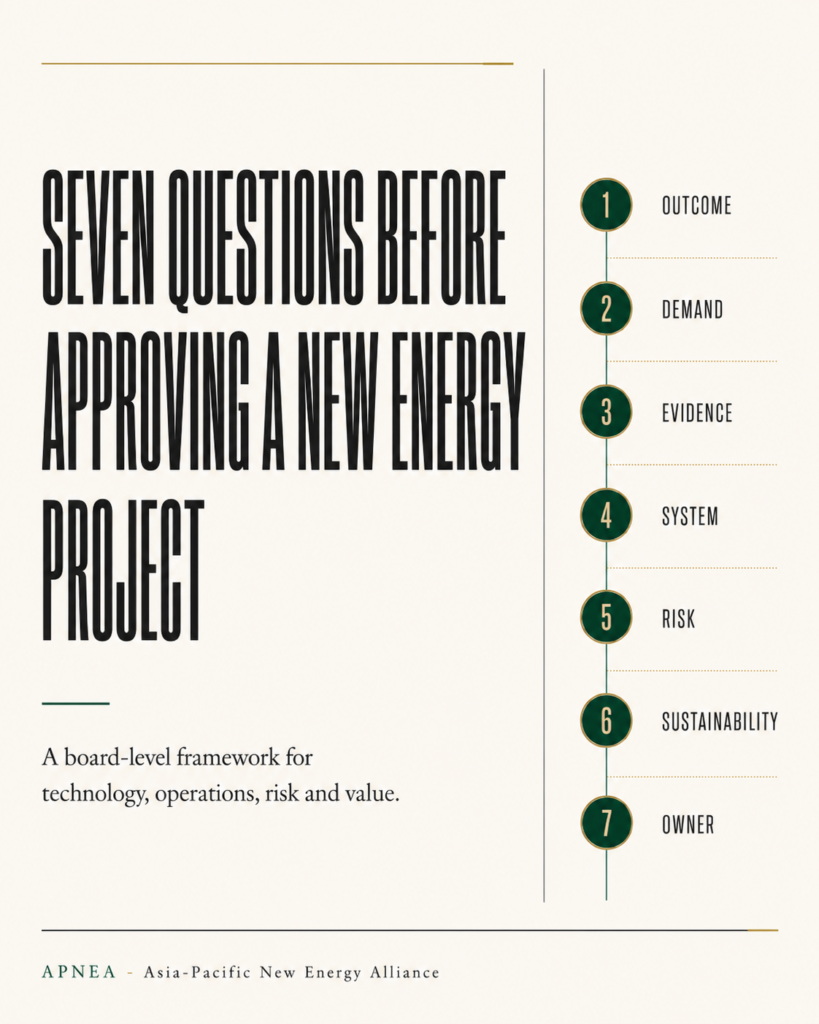
A board-quality approval therefore needs seven answers. The project must advance a defined strategic outcome. Demand must be real enough to govern capacity and commitment. Evidence must match the intended conditions. The surrounding system must be ready for normal and degraded operation. Residual risks and compliance exposure must remain visible. Sustainability and economics must use the same assumptions. Finally, one accountable owner must control the next gate and the conditions to stop, redesign, pause or redirect.
Approve the operating system, not only the technology object.
How to use this executive brief
Use the seven questions before procurement, pilot approval, capital release, regional partnership approval or transition-plan commitment. They are not a substitute for technical due diligence. They are the governance frame that determines which technical, commercial, regulatory and operating evidence must be brought into the decision.
Each question should produce three things: a direct answer, the evidence supporting that answer and the person authorised to act if the evidence changes. An answer that cannot be connected to an owner or a future gate is not yet decision-ready.
- Write the intended decision and the amount of commitment being requested.
- Record which evidence is verified, which is assumed and which remains unavailable.
- Separate evidence that can travel across markets from conditions requiring local acceptance.
- Define the next dated gate and the evidence threshold for continuation.
- Pre-agree the conditions for redesign, pause, stop or redirection.
1. Which strategic outcome does the project advance?
A project should begin with the service, capability, resilience or decarbonisation outcome it is expected to create. It should not begin with enthusiasm for a technology category. The strategic outcome establishes why the project exists, which alternative routes must be compared and which result would justify further commitment.
The first discipline is to separate the desired outcome from the proposed object. A fleet may need dependable low-emission transport, not merely electric vehicles. A site may need resilient energy service, not merely a battery. An industrial user may need a reliable low-emissions molecule under defined conditions, not merely a hydrogen project. When the outcome is defined independently, the board can test whether the proposed route is the strongest available option.
The outcome must also be measurable within a relevant timeframe. A broad ambition such as innovation leadership or sustainability improvement is insufficient unless the project specifies which performance, cost, risk, capability or emissions result will change and how the next gate will recognise that change.
Decision-gate questions
- Which service, capability, resilience or decarbonisation objective is being advanced?
- Why does the outcome matter now, and why is this project the preferred route?
- Which simpler, lower-risk or lower-cost alternative has been tested?
- Which measurable result would justify continuation or scale?
Board signal: The project is connected to a defined outcome, not technology interest.
2. Who needs the service, and how firm is demand?
Demand should move through a visible chain from end user to contracted or accountable requirement. Interest, forecasts, policy ambition and expressions of support may be useful signals, but they do not carry the same weight as an operating obligation, committed buyer, funded service requirement or named internal owner.
The decision should identify who receives the service or product, which performance cannot be compromised, how much volume is current or expected, when demand must exist and who is accountable for the commitment. This prevents a project from treating a possible future market as if it were already an operating requirement.
Demand quality also determines the correct scale of investment. Early evidence may justify a small learning programme. Repeatable service demand may justify enabling infrastructure. Firm, timed and accountable demand may justify larger commitments. Treating all three as equivalent encourages premature scale and hides the cost of unused capacity.
Demand evidence ladder
- User: Who receives the service or product?
- Requirement: Which performance, availability or quality cannot be compromised?
- Volume: What is current, expected and firm?
- Timing: When must the demand exist, and for how long?
- Commitment: Which buyer, operator, sponsor or asset owner is accountable?
Board signal: Demand is evidenced beyond a forecast or expression of interest.
3. What has been proven in the intended conditions?
Evidence should match the scale and consequence of the decision. A controlled test can prove a defined function. A pilot can prove integration under selected conditions. Repeated operation can provide evidence of reliability over time. Destination-context evidence tests whether local climate, regulation, infrastructure, workforce, supply and operating practice change the result.
These levels are cumulative, not interchangeable. A successful laboratory result does not prove site integration. A successful pilot does not prove repeatable performance across difficult days. Repeated operation in one market does not automatically prove acceptance in another. The evidence package should therefore state the configuration, method, conditions, duration, exclusions and remaining uncertainty.
The board does not need to reproduce the technical review. It needs to know whether the evidence is relevant to the decision being requested. Evidence quality is weak when it is technically credible but attached to the wrong operating condition, product configuration, duty cycle, jurisdiction or scale.
Evidence levels and their limitations
- Controlled test: Proves a defined function, but not full-system integration.
- Pilot: Proves integration under selected conditions, but may not capture difficult or degraded operation.
- Repeated operation: Proves performance and reliability over time, but only within the observed boundary.
- Destination context: Tests local rules, climate, infrastructure, competence, acceptance and operating practice.
Board signal: Evidence quality matches the scale of the decision.
4. Can the surrounding system support the technology?
New-energy projects operate through dependencies. Site and grid capacity, supply-chain continuity, workforce competence, maintenance access, data and controls, emergency response, permits and standards can determine whether the technology produces a reliable operating outcome.
The system must be tested in normal and degraded conditions. Normal-operation plans explain how the service works when every dependency is available. Degraded-operation plans explain what happens during a grid constraint, communications loss, equipment failure, delayed supply, unavailable technician, missing data or emergency condition. A project that has only a normal-day operating model has not yet established readiness.
The dependency review should assign capacity, owner, fallback and escalation logic. External reliance does not remove internal accountability. If the project depends on a utility, supplier, regulator, laboratory, service contractor or public authority, an internal owner should still monitor the dependency, influence it where possible and escalate when the evidence changes.
The IEA Global EV Outlook examines vehicle deployment together with charging infrastructure, battery demand, policy and electricity-system implications, while the Global Hydrogen Review examines production and demand alongside infrastructure, trade, investment and policy.12 The lesson is broader than either technology: the outcome is produced by a system of connected conditions.
Minimum dependency map
- Site and grid
- Supply chain and service support
- Workforce and authorisation
- Maintenance and spares
- Data, communications and controls
- Emergency response and recovery
- Permits, standards and destination-market acceptance
Board signal: Critical dependencies have owners, capacity and fallback plans.
5. Which risk remains after approval?
Approval does not remove risk. It transfers, retains or accepts exposure. The decision paper should identify which safety, regulatory, cyber and data, insurance, supply, environmental, end-of-life, financial and reputational risks remain with the organisation after approval.
A useful risk statement names the exposure, the owner, the control, the evidence used to judge the control and the escalation threshold. It should not hide behind a single overall score. Two projects with the same headline rating may have very different failure pathways, decision rights and consequences.
The board should also distinguish controllable risks from external dependencies. A supplier may own delivery of an item, but the organisation still owns the consequence of delay. A regulator may control approval timing, but the project still needs a contingency and a decision date. An insurer may transfer part of the financial consequence, but it does not operate the safety barriers or restore the service.
Illustrative risk-attention categories
- Safety and abnormal events
- Regulation, permitting and standards
- Cybersecurity, data integrity and control authority
- Insurance coverage and uninsurable exposure
- Supply continuity and vendor dependency
- Lifecycle, end-of-life and environmental responsibility
Board signal: Residual risks, decision owners and escalation thresholds are explicit.
6. Do sustainability and economics use the same assumptions?
A project can appear attractive when the sustainability case and the economic case describe different systems. One model may assume high utilisation while the other uses a conservative operating volume. One may include infrastructure and end of life while the other ends at the equipment boundary. One may compare against the current service while the other compares against an idealised alternative.
The two assessments should use the same required service, included boundary, utilisation, timeframe, asset life, maintenance logic, end-of-life treatment and normal, downside and degraded scenarios. This does not mean that every metric is combined. It means that the models are anchored to the same operating reality.
The GHG Protocol emphasises defined organisational boundaries and consistent accounting, while its Scope 2 Guidance standardises the treatment of purchased electricity, steam, heat and cooling.4 IFRS S2 transition-plan guidance likewise highlights strategic goals, targets, actions, resources, key assumptions, dependencies, scenario analysis and financial effects.5 These disciplines support a simple executive requirement: benefits, costs and impacts should not be calculated from different realities.
The dual-ledger alignment test
- Service: Same required outcome
- Boundary: Same included system
- Utilisation: Same operating volume and time
- Lifecycle: Same asset life, maintenance and end of life
- Scenario: Same normal, downside and degraded conditions
Board signal: Benefits, costs and impacts are not calculated from different realities.
7. Who owns the next gate and the stop decision?
Governance becomes real when one accountable executive owns the next dated decision, the evidence threshold and the conditions that prevent escalation of commitment. Without that structure, a stage gate can become a progress update in which activity, spend and enthusiasm substitute for a decision.
The stop criterion deserves the same attention as the approval criterion. Each new commitment makes previous decisions harder to challenge. Pre-agreed stop or redirect conditions protect the organisation from allowing sunk cost, public commitment or stakeholder enthusiasm to determine the next step.
Strong governance does not slow innovation. It creates a credible path to scale and a disciplined path to stop. The board can protect a promising option, demand the correct evidence and release only the commitment required to reach the next decision.
Four fields for the decision memo
- Owner: One accountable executive
- Next gate: One dated decision
- Required evidence: A defined approval threshold
- Stop or redirect: Pre-agreed conditions that prevent escalation of commitment
Board signal: The next decision, evidence threshold and stop condition are approved together.
One-page project approval memo
The seven questions can be consolidated into one approval memo. The board answer should be brief enough to expose ambiguity. Detailed technical and commercial evidence can sit behind the memo, but the gate itself should state what is known, what remains assumed and which decision follows.
| Decision field | Required board answer | Evidence to attach |
|---|---|---|
| Strategic outcome | The specific service, capability, resilience or decarbonisation result | Outcome measure, alternative analysis and decision timeframe |
| Demand and service | The user, non-negotiable requirement, volume, timing and accountable commitment | Operating need, contract, service obligation or approved forecast basis |
| Technical evidence | What has been proven, in which configuration and conditions | Test, pilot, repeated-operation and destination-context evidence |
| System readiness | Which dependencies must work in normal and degraded operation | Capacity, owner, fallback, commissioning and recovery evidence |
| Residual risk | Which exposure remains and who can accept or escalate it | Risk register, control evidence, insurance position and compliance route |
| Sustainability and economics | The common service, boundary, utilisation, lifecycle and scenarios | Aligned assumptions, sensitivity analysis and transparent limitations |
| Governance and stop criteria | The next gate, evidence threshold, owner and stop or redirect conditions | Dated decision memo and pre-agreed intervention triggers |
Conclusion
The core executive question is not whether a new-energy technology is interesting or technically possible. It is whether the organisation should own the operating, financial, regulatory and reputational exposure required to create the intended outcome.
A credible approval connects outcome, demand, evidence, dependencies, risk, aligned assumptions and ownership. It also preserves the ability to stop. When these elements are visible, innovation has a stronger path to scale. When they are absent, approval can become a commitment to solve the operating system after the technology has already been selected.
Approve the operating system, not only the technology object.
Selected references
- International Energy Agency, Global EV Outlook 2026. Shows why electric mobility decisions connect deployment, charging infrastructure, battery demand, policy, electricity use and emissions rather than one technology object.
- International Energy Agency, Global Hydrogen Review 2026. Frames hydrogen deployment through production, demand, policy, infrastructure, trade, investment and innovation.
- ASEAN Centre for Energy, ASEAN Plan of Action for Energy Cooperation 2026-2030. Regional context for cooperation, connectivity, energy security, resilience and an inclusive energy transition.
- GHG Protocol, Corporate Standard and Scope 2 Guidance. Supports consistent organisational boundaries and transparent treatment of purchased-energy emissions.
- IFRS Foundation, Disclosing information about climate-related transition plans in accordance with IFRS S2. Supports explicit strategic goals, targets, actions, resources, assumptions, dependencies, scenario analysis and financial effects.
Use the evidence within its stated scope.
This publication provides general professional and institutional knowledge to support evidence-led discussion and decision framing. Project-specific decisions should be considered alongside relevant professional, regulatory and destination-market requirements.