
Executive summary
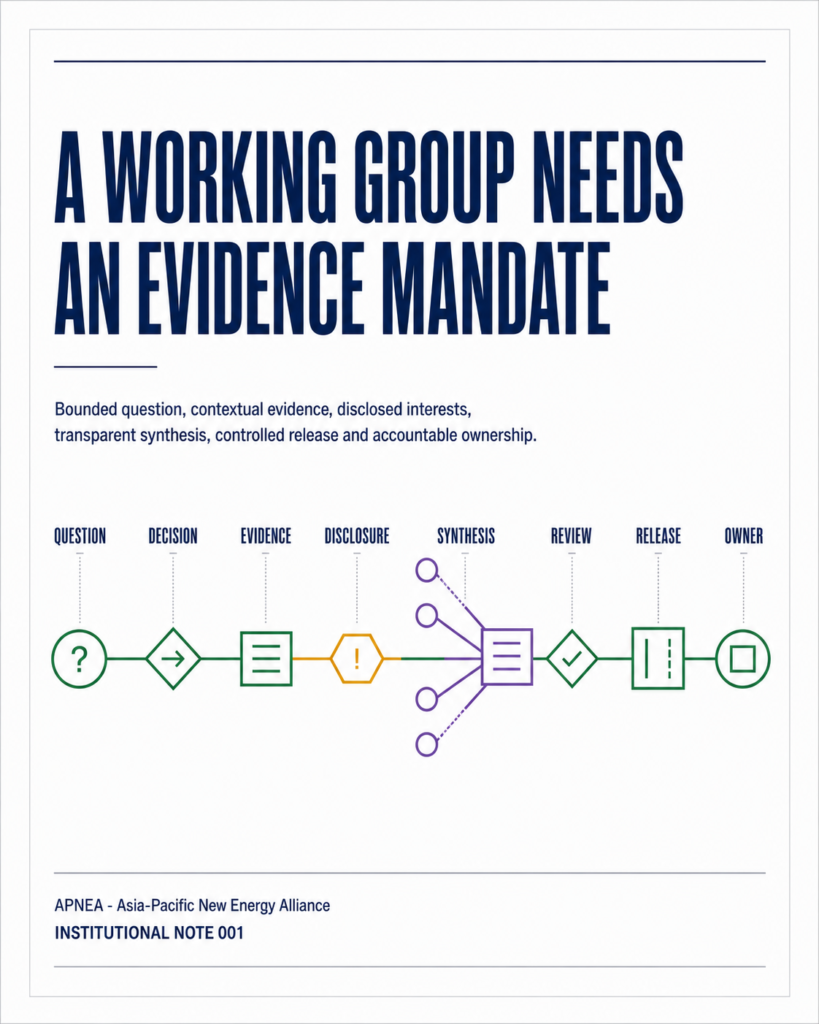
This working group evidence mandate provides the controls required to turn regional dialogue into a traceable and reusable institutional output.Regional dialogue becomes useful when it leaves behind evidence that other people can inspect, interpret and apply. A meeting series can create relationships and surface ideas, but those benefits do not automatically produce a reliable regional output. A serious working group needs an evidence mandate before the first discussion.
The mandate should define one bounded question, the practical decision or capability the work is intended to improve, the contexts that must be compared, the evidence that participants may contribute, the interests that must be disclosed, the method for synthesising different views, the review and permission controls, the release standard and the owner responsible after publication. This structure reflects the approved APNEA Day 30 framework and the Alliance working-group protocol. 18
The wider institutional logic is well established. ISO and IEC technical work is governed through transparency, openness, impartiality, consensus and clearly defined scopes. Their current directives recognise that consensus requires time for discussion, negotiation and resolution of significant technical disagreement. 2 UNESCO links openness with scrutiny, critique, reproducibility and trust in evidence. 4 WHO guideline methods show the importance of structured questions, relevant constituencies, declarations of interest, external review and explicit assessment of evidence quality. 5
These processes are not interchangeable, and an APNEA working group is not an ISO committee, scientific assessment body or regulatory panel. They nevertheless demonstrate a common institutional lesson: useful collective knowledge is produced through defined questions, traceable inputs, visible interests, disciplined synthesis and controlled decisions, not by attendance alone.
This working group evidence mandate provides a practical protocol for regional groups across APNEA’s seven domains. It is designed for proposed committees, short working groups, institutional collaborations and publication projects that need to compare operating experience, research, standards awareness and cross-market perspectives without collapsing legitimate differences.
A working group should be able to explain what it will answer, what evidence it will use, how disagreement will be preserved, who may release the output and who owns the result after the meeting ends.
1. Begin with the decision and intended output
Many working groups begin by inviting prominent participants and then asking what they would like to discuss. This can generate a broad agenda, but it often leaves the group without a decision boundary. Participants may use the same words while addressing different problems, lifecycle stages, markets or intended users.
The first control is therefore not the participant list. It is a decision statement. The convenor should identify who will use the output, what practical choice or capability it should improve, and which form of output is proportionate. A regional comparison note, operating checklist, terminology map, training outline and policy discussion brief require different evidence and review methods.
The statement should not promise consensus, endorsement, certification, funding, procurement or market access. It should state the intended use and the limits of that use. This protects contributors from having their evidence repurposed beyond the agreed mandate and protects readers from mistaking a dialogue output for project-specific advice.
Decision-first initiation test
- Named user of the result, such as an operator, institution, programme owner, procurement team, educator or public-sector stakeholder.
- Practical decision, capability or shared understanding the work should improve.
- Output type and expected level of depth.
- Lifecycle stage and geographic contexts covered.
- Explicit matters the group will not decide.
- Named sponsor or convenor with authority to approve the mandate.
- Closure condition that prevents an open-ended meeting series.
Working signal: every participant can state the intended user, the practical decision and the matters that remain outside scope.
2. Bound the regional question before collecting evidence
A useful regional question is narrow enough to answer and broad enough to matter in more than one context. Questions that ask whether a technology is good, sustainable, safe or ready are too broad. The group must identify the service, asset, decision, evidence boundary and contexts being compared.
Regional scope should also be selective. Adding more countries does not automatically improve the output. Each context should be included because it changes a relevant assumption, method, operating condition, standards route, workforce capability or decision consequence. Where a market is outside the available evidence, the limitation should be stated rather than filled with inference.
Terms should be operationally defined at the start. Words such as low carbon, circular, renewable, efficient, responsible and market ready can conceal incompatible boundaries, time periods and methods. The group should make the term, boundary, method, evidence and limitation visible before it attempts comparison. This principle is part of the APNEA campaign close and supports evidence that can be used without false equivalence. 1
Question-boundary register
| Boundary field | Required answer | Failure if omitted |
|---|---|---|
| Decision | Which practical choice, capability or shared understanding should improve? | The group produces discussion without a usable result. |
| Domain | Which technical, operating, workforce, carbon or standards issue is included? | Evidence from different problems is blended together. |
| Geography | Which markets or contexts need comparison, and why? | Country names substitute for relevant system differences. |
| Stakeholders | Whose evidence, experience and decision rights are material? | Participation becomes ceremonial or unbalanced. |
| Time boundary | Which date, lifecycle stage and policy or standards editions apply? | The output combines evidence that was valid under different conditions. |
| Exclusions | Which commercial, political, regulatory or project-specific matters remain outside scope? | Readers over-apply the conclusion. |
Working signal: the exact question can be written in one sentence, and the group can also state what it will not attempt to decide.
3. Select participants by contribution and review role
Representation matters, but a working group is not strengthened merely by increasing the number of organisations around the table. Participants should be selected because they contribute relevant evidence, provide a necessary context, review a material interpretation, represent an affected user group or hold a decision right connected to the intended output.
ISO’s technical-work code emphasises a clear purpose and scope, active participation, consensus, transparency and impartiality in a multi-stakeholder environment. 3 WHO guideline methods similarly distinguish researchers, end users, community representatives and evidence-synthesis experts while managing declarations of interest and external review. 5 The practical lesson is to design the participant architecture around the work, not around prestige or sector labels.
The convenor should distinguish contributor, reviewer, observer, secretariat and decision-owner roles. A participant may hold more than one role, but the overlap must remain visible. An organisation that funds the work or owns relevant data may contribute legitimate expertise while requiring stronger disclosure and review controls.
Participant-role map
| Role | Primary responsibility | Control question |
|---|---|---|
| Contributor | Provide evidence, experience, data, methods or contextual interpretation. | What exact contribution is expected and under which permission? |
| Context representative | Explain market, user, workforce, institutional or operating conditions. | Is the represented perspective identified accurately and proportionately? |
| Technical reviewer | Check accuracy, method, terminology, limitations and interpretation. | Is the reviewer sufficiently independent from the claim or contribution? |
| Secretariat or synthesis lead | Maintain scope, records, evidence traceability and draft control. | Can every material statement be traced to evidence or a recorded interpretation? |
| Observer | Follow the process without controlling evidence or conclusions. | Are access, confidentiality and speaking rights clear? |
| Decision owner | Accept, return, limit, release, update or retire the output. | Does this role have the authority and capacity to maintain the result? |
Working signal: every participant has a defined contribution or governance role, and attendance is not treated as endorsement of the final output.
4. Specify admissible evidence and the minimum context
Experience becomes reusable only when its source, context, method and limitation are visible. A statement that a system worked, failed or achieved a result cannot be compared responsibly without knowing the asset or service, conditions, method, boundary, timeframe and evidence quality.
UNESCO’s Recommendation on Open Science links transparency, scrutiny, critique and reproducibility with stronger and more trusted knowledge. 4 The IPCC assessment method similarly connects findings to underlying literature evaluated through evidence, agreement, confidence and, where applicable, likelihood. 7 An institutional working group does not need to reproduce these scientific methods, but it should preserve the same discipline of traceability and explicit limitation.
The evidence mandate should identify what evidence is admissible, the minimum context required for each type and how confidential or proprietary material will be handled. Where original data cannot be circulated, the group should decide whether a controlled summary, anonymised record, independent review or exclusion is appropriate. Confidentiality should not be used to convert an unverifiable claim into a common finding.
Evidence-contribution standard
| Contribution type | Minimum context to record | Typical limitation to preserve |
|---|---|---|
| Operating practice | Asset, service, location, operating conditions, timeframe and responsible function. | Practice may not transfer to a different duty, climate, scale or regulatory context. |
| Technical result | Method, boundary, sample, configuration, uncertainty, exclusions and data owner. | Result may not apply outside the tested method or configuration. |
| Standard or policy | Jurisdiction, issuing body, edition, status, applicability and effective date. | Published text may not show current local implementation or enforcement. |
| Research | Question, design, sample, method, peer-review status, uncertainty and limitations. | Research evidence may not establish operational feasibility or local acceptance. |
| Incident or lesson | System state, event sequence, control failure, response and confidentiality treatment. | An anonymised lesson may not support attribution or frequency claims. |
| User or workforce experience | Whose perspective, selection method, conditions and collection method. | Experience should not be presented as representative without a valid basis. |
Working signal: every contribution carries enough context to be compared without being misapplied.
5. Disclose interests and govern representation
Neutrality does not require participants to have no interest. Corporations, universities, professional bodies, public institutions, researchers, technology providers and users all bring legitimate positions and incentives. Neutrality requires relevant interests to be visible and governed so that readers can distinguish evidence, institutional position, advocacy and interpretation.
OECD guidance recommends adequate disclosure, effective management of conflicts, transparent decision records and review of conflict-of-interest controls. 6 Disclosure is therefore not a one-time declaration stored away from the work. It should inform role assignment, access to confidential material, review independence, drafting authority, recusal decisions and the way positions are attributed.
The group should record commercial positions, material funding, regulatory or public roles, data ownership, publication interests and preferred outcomes relevant to the mandate. The control should be proportionate. Some interests require attribution only; others may require an additional reviewer, separation from the synthesis decision, restricted access or recusal from a release decision.
Interest-control sequence
- Declare the relevant commercial, funding, institutional, regulatory, data and publication interests.
- Assess how each interest could affect contribution, interpretation, review or release.
- Record the control, such as attribution, independent review, role separation, restricted access or recusal.
- Revisit disclosures when scope, evidence, participants or intended use changes.
- Keep the decision record sufficient for a reader or governance body to understand how material interests were managed.
Working signal: readers can understand relevant interests without dismissing legitimate expertise, and no single interest can control the conclusion invisibly.
6. Synthesize evidence without erasing regional difference
Regional variation is often the finding, not a defect to be edited away. Different outcomes may result from grid conditions, climate, service requirements, infrastructure maturity, regulation, standards adoption, workforce capability, procurement practice or data quality. A useful synthesis should identify which differences are material and why.
Consensus should not be manufactured by removing difficult evidence or rewriting minority interpretations into vague language. The ISO/IEC Directives treat consensus as a process that requires discussion, negotiation and resolution of significant objections, rather than simple unanimity or speed. 2 For an APNEA institutional note, the synthesis method should preserve common evidence, contextual differences, open questions, reasoned minority views and limitations.
The synthesis lead should separate evidence from judgement. A source can be accurate while supporting more than one interpretation. Where evidence is insufficient, the output should state the unresolved question and the evidence needed next. Where a statement applies only in one market or operating condition, the boundary should travel with the statement.
Required synthesis labels
| Label | Use | Release test |
|---|---|---|
| Common finding | Evidence or conclusion supported across the contexts examined. | Can the supporting evidence and applicable contexts be traced? |
| Contextual difference | Variation linked to a market, system, operating or institutional condition. | Is the reason for the difference explained rather than merely listed? |
| Open question | Material issue not resolved by the available evidence. | Does the output identify what evidence or decision is still required? |
| Minority view | Reasoned interpretation retained where consensus is absent. | Is the view represented accurately and linked to its rationale? |
| Limitation | Boundary that prevents broader application. | Will the limitation remain visible when the conclusion is quoted or reused? |
Working signal: the output distinguishes agreement, variation, uncertainty and unresolved disagreement instead of blending them into one regional statement.
7. Pre-agree review, permission and release conditions
Publication should be a governed decision, not the automatic end of a meeting series. Before drafting begins, the mandate should identify who reviews technical accuracy, who checks scope and neutrality, who confirms attribution and permissions, who makes the release decision and what happens when a condition is not met.
Review should be matched to the claims. Technical results may require a method specialist. Regulatory or standards statements may require edition and jurisdiction checks. User or workforce conclusions may need review of collection and representation methods. Commercially sensitive evidence requires a permission and confidentiality review. The group should avoid asking one general reviewer to validate every type of claim.
WHO methods illustrate a structured combination of evidence review, declarations of interest, external review, public comment and consensus or voting when needed. 5 APNEA outputs will use a proportionate process, but the release record should still show which controls were applied and which were not applicable.
Publication release gate
| Release condition | Required evidence | Decision if incomplete |
|---|---|---|
| Scope confirmed | The output answers the agreed question and respects exclusions. | Return for scope correction. |
| Evidence traceable | Material claims link to permitted sources, records or attributed interpretation. | Remove, qualify or obtain supporting evidence. |
| Interests disclosed | Relevant positions, funding, ownership and limitations are visible and controlled. | Add disclosure or revise role and review controls. |
| Technical review completed | Appropriate reviewers have checked accuracy, method and interpretation. | Return for specialist review. |
| Permissions cleared | Confidentiality, attribution, copyright and data-use rights are respected. | Withhold or replace the affected material. |
| Owner assigned | A named function will maintain, update, correct or retire the output. | Do not release as a maintained institutional output. |
Working signal: the release decision records what was approved, by whom, under which limitations and with which maintenance responsibility.
8. Assign ownership, maintenance and closure
A publication can become misleading after release even when it was accurate on the publication date. Standards editions change, policies are revised, systems mature, new evidence emerges and organisational relationships evolve. The working group therefore needs an owner who can correct, update, supersede or retire the output.
Ownership is not only editorial. The owner should maintain the source register, decision record, permissions, version history, correction route and review date. The owner should also determine whether the group continues, closes or reconvenes around a new mandate. An indefinite working group without a new question or output can turn participation into an activity metric rather than a capability-building mechanism.
The output should identify its status clearly: draft for consultation, working note, final institutional note, superseded version or retired document. Where an output is reused in training, procurement, policy dialogue or public communication, the reuse should preserve the original boundary and limitations.
Maintenance triggers
- Material new evidence changes a common finding or limitation.
- A referenced standard, policy, regulation or method is revised.
- A contributor identifies an error, misattribution or permission issue.
- The intended use expands beyond the approved mandate.
- A market or operating context changes enough to affect transferability.
- The named owner, sponsor or responsible institution changes.
- The review date is reached without confirmation that the output remains current.
Working signal: the output has a named owner, version status, review date, correction route and retirement condition.
9. Use one evidence mandate before the first meeting
The evidence mandate should be concise enough to govern the work and detailed enough to prevent scope drift. It is not a full project plan. It is the institutional contract that connects the question, participants, evidence, synthesis, release and ownership decisions.
The mandate can be approved as a one-page record before invitations are finalised. Changes should be version-controlled and communicated to contributors. A material change to the question, intended user, evidence permissions or publication purpose may require renewed agreement and disclosure review.
APNEA working-group evidence mandate
| Mandate field | Minimum content | Named owner or approver |
|---|---|---|
| Regional question | One bounded question and the practical decision or capability it should improve. | Sponsor or convenor |
| Scope and exclusions | Domain, geography, lifecycle stage, timeframe, terms and matters outside scope. | Convenor and technical lead |
| Participants and roles | Contributors, context representatives, reviewers, observers, secretariat and decision owner. | Convenor |
| Evidence rules | Admissible evidence types, minimum context, quality treatment and confidentiality route. | Evidence or methods lead |
| Interest controls | Required disclosures, assessment method, attribution, review separation and recusal rules. | Governance owner |
| Synthesis method | How common findings, differences, open questions, minority views and limitations will be recorded. | Synthesis lead |
| Review plan | Technical, contextual, legal or permission reviews required for the planned claims. | Publication owner |
| Release standard | Approval authority, permission checks, release status and return-for-review conditions. | Decision owner |
| Maintenance and closure | Version, review date, correction route, update triggers, retirement and group closure. | Output owner |
A working group should not proceed to substantive discussion until the sponsor and convenor can answer each field. Where information is not yet available, the gap should be treated as an initiation task rather than an assumption.
Mandate test: can the group contribute credible evidence, respect a neutral process and produce a result that others can use without losing its context?
Conclusion
Regional collaboration is most valuable when expertise enters a neutral process and returns as reusable capability. That requires more than productive meetings. It requires a bounded question, relevant participation, contextual evidence, visible interests, disciplined synthesis, appropriate review, controlled release and accountable ownership.
The evidence mandate does not eliminate disagreement or guarantee that one regional answer exists. Its purpose is to make agreement, variation, uncertainty and limitation legible. This is particularly important across APNEA’s connected domains, where technical evidence, operating conditions, standards routes, workforce realities and institutional responsibilities differ across markets.
APNEA can use this protocol to initiate proposed committees, short working groups and institutional collaborations without overstating authority or manufacturing consensus. Each group should begin only when it has a useful question, qualified contributions and an owner for the output. It should close when the mandate is complete, the evidence is insufficient or another institution is better placed to lead the next decision.
Dialogue becomes regional capability when the result is bounded, traceable, reviewable, reusable and owned.
References
- APNEA. LinkedIn Content Production Plan, Days 21-30, Day 30: A Working Group Needs an Evidence Mandate. Internal editorial source.
- International Organization for Standardization and International Electrotechnical Commission. ISO/IEC Directives, Part 1, Consolidated ISO Supplement, current 2026 edition.
- International Organization for Standardization. ISO Code of Conduct for the technical work.
- UNESCO. Recommendation on Open Science.
- World Health Organization. Methods used for guideline development and evidence assessment.
- Organisation for Economic Co-operation and Development. Recommendation of the Council on Guidelines for Managing Conflict of Interest in the Public Service.
- Intergovernmental Panel on Climate Change. AR6 Working Group I, Chapter 1: Framing, Context and Methods.
- APNEA. Website Architecture and Content Blueprint and Get Involved working-group protocol. Internal website source.
Use the evidence within its stated scope.
This institutional note provides a general governance protocol for regional working groups, committees, institutional collaborations and publication projects. It synthesises approved APNEA material on bounded questions, contextual evidence, disclosure, synthesis, review, release and ownership with institutional methods from ISO, UNESCO, WHO, the OECD and the IPCC. It does not convert an APNEA working group into a standards committee, scientific assessment body, regulatory panel, certification process, legal review or project approval mechanism. It does not constitute project-specific legal, regulatory, engineering, scientific, assurance, investment, employment, competition, data-protection, confidentiality or intellectual-property advice. The mandate, participant roles, disclosures, evidence permissions, review methods and release conditions must be adapted to the subject, jurisdiction and intended use. Confidential, personal, proprietary or controlled information must not be contributed or published without appropriate authority and safeguards.